- Last Update15-Apr-2026


- Tweet
-
Jordan, UAE sign deal to implement landmark Aqaba Railway Project
The Jordan Times
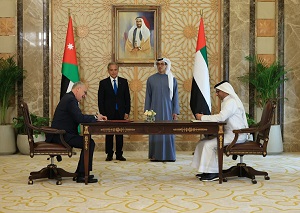
AMMAN — Prime Minister Jafar Hassan and UAE Vice President, Deputy Prime Minister and Chairman of the Presidential Court Sheikh Mansour Bin Zayed Al Nahyan on Wednesday witnessed the signing of agreements to launch the implementation of the Aqaba Port Railway project.
The landmark project involves the establishment of a joint Jordanian-Emirati company tasked with the construction and operation of the railway, the public service broadcaster Al Mamlaka reported.
The venture is a 50-50 partnership between Jordan, represented by the Jordan Phosphate Mines Company, Arab Potash Company, the Government Investments Management Company, and the Social Security Investment Fund, and the UAE, represented by L'Imad Holding Company, the sovereign investment platform of the Abu Dhabi government.
The project is the largest of its kind in the Kingdom's history, with a total joint investment estimated at $2.3 billion.
It includes a massive infrastructure package featuring railway tracks, tunnels, and bridges designed according to the highest international standards.
This strategic initiative aims to bolster the economic competitiveness of the Port of Aqaba, positioning it as a regional gateway for transport, shipping, and logistics.
It is expected to stimulate wide-scale development across the Kingdom, particularly in the southern governorates and the Ghor regions.
The railway serves as the first step in building Jordan's National Railway Network, which seeks to connect Aqaba and the Kingdom with neighbouring Arab countries and link the port to Syrian and Mediterranean ports.
The project is an extension of the $5.5 billion joint investment agreement signed in late 2023 in the presence of His Majesty King Abdullah and UAE President Sheikh Mohamed Bin Zayed Al Nahyan.
Beyond its logistical impact, the project is set to transform the transport sector by directly linking mining sites to ports, reducing transport costs, improving supply chain efficiency, and doubling potash and phosphate exports.
It will serve as a primary lever for the mining sector, enhancing its operational efficiency and the global competitiveness of related industries.
The 360-kilometre railway network will connect phosphate and potash mines to the industrial port through two main tracks serving production sites in Sheidiya and Ghor Al Safi. The network is expected to transport approximately 16 million tonnes of minerals annually, including 13 million tonnes of phosphate and 2.6 million tonnes of potash.
The government has also begun studies to link the Sheidiya mining route to the Maan Development Area, integrating with plans for a Maan-Aqaba land port to serve as a new logistical, customs, and industrial hub.
Financial closure for the project is expected in early 2027, with implementation scheduled over a five-year period.
The project will create numerous direct and indirect jobs in the transport, mining, and logistics sectors.
The government has committed to allocating funds to compensate landowners in the Ghor areas or provide fair alternative plots for those affected by land acquisitions for the project.
L'Imad Holding will provide advanced technical expertise in railway development and operation, while working to build specialised national capacities in the sector.
During their meeting, Hassan and Sheikh Mansour emphasised that these agreements embody the deep-rooted ties and the expanding economic and investment partnership between the two nations.
Latest News
-
 US-Iran talks fail, raising fears of renewed escalation
-
 Trump warns Iran boats breaching US blockade will be 'eliminated'
-
 Jordan, Syria deepen strategic ties at high-level council meeting in Amman
-
 King receives Syrian delegation participating in ministerial meetings
-
 US-Iran talks fail as world urges respect for truce