- Last Update15-Jul-2026


- Tweet
-
From Nuclear to Hormuz - By Mohammad Abu Rumman, The Jordan Times
The latest military escalation between the United States and Iran is not simply a return to confrontation after weeks of relative calm. Rather, it exposes the structural flaw embedded in the ceasefire agreement from the very beginning. The fundamental question that every war ultimately raises—who won and who lost—was never truly resolved. Instead of producing a durable political settlement, the memorandum of understanding merely froze the battlefield while postponing the most contentious issues, including the future of the Strait of Hormuz, the Israeli withdrawal, and Iran's frozen assets. Those unresolved questions have now become the new center of the conflict.
The key question today is not only whether the war will resume, but whether the memorandum itself is effectively dead, as President Donald Trump has declared. The more plausible reading is that the agreement has entered a state of suspension. Negotiators in both Washington and Tehran have stepped back, leaving room for hardliners on both sides to create new facts on the ground and accumulate leverage before negotiations eventually resume.
The difficulty is that the issues now at stake do not lend themselves to easy compromise. Nowhere is this more evident than in the Strait of Hormuz, which, from the perspective of Iran's Islamic Revolutionary Guard Corps (IRGC), has evolved from a strategic waterway into perhaps a more valuable instrument of leverage than Iran's nuclear program itself. Recent statements by senior Iranian officials leave little doubt that this is now how Tehran increasingly views the Strait.
Although predicting the next phase of the conflict remains difficult, one major transformation is already evident: the center of gravity has shifted. At the outset of the war, Iran's nuclear and missile programs dominated the agenda, while some voices in Washington and Tel Aviv openly discussed weakening—or even transforming—the Iranian regime. Today, however, the strategic focus has moved decisively toward the Strait of Hormuz.
This is more than a change in priorities. It reflects a shift from competing over Iran's military capabilities to competing over strategic geography. Hormuz is no longer simply an Iranian or American issue; it has become a question of global energy security, international trade, and the stability of one of the world's most vital maritime chokepoints. Consequently, the conflict now directly affects a much broader range of regional and international actors.
This shift also explains the changing position of the Gulf states. At the beginning of the war, they largely managed to distance themselves from the confrontation. Today, however, the crisis directly threatens their national security and economic stability. Maintaining strategic neutrality has become far more difficult, even if Gulf capitals continue to differ in the degree and form of their engagement. The growing role of the Houthis further reinforces this trend by raising concerns that the confrontation could expand from Hormuz to the Bab el-Mandeb Strait, placing maritime security at the center of the regional agenda.
At the same time, Iran itself appears to be reassessing the foundations of its regional strategy. For two decades, Tehran relied primarily on a network of non-state allies and proxies to project influence across the region. The recent war, however, has highlighted the renewed strategic value of geography itself. For the IRGC, Hormuz is no longer merely a bargaining chip; it is central to both an internal struggle over influence within what some describe as Iran's emerging "Third Republic" and a broader regional effort to redefine Iran's post-war role.
Against this backdrop, the prospects for an early diplomatic breakthrough appear increasingly limited. Limited military escalation is likely to continue, not because either side necessarily seeks a full-scale war, but because both are attempting to strengthen their negotiating positions before returning to diplomacy.
This recalls Carl von Clausewitz's famous observation that war is "the continuation of politics by other means." What we are witnessing today is precisely that. The conflict has not abandoned politics; it has simply shifted its battlefield—from uranium enrichment to the Strait of Hormuz, and from the nuclear file to the geopolitics of strategic waterways.
Latest News
-
 Air defences shoot down four missiles launched from Iran — JAF
-
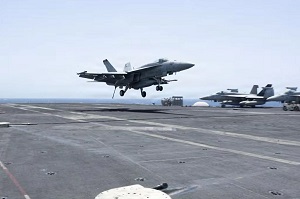 US widens strikes as Iran closes Hormuz
-
 King condoles Qatar over passing of former emir Sheikh Hamad
-
 Three Iranian missiles land in Jordan, cause minor damage — JAF
-
 US Attacks Iran, IRGC Says Strait of Hormuz to Remain Closed ‘Until Further Notice’