- Last Update09-Mar-2026


- Tweet
-
When chaos backfires: How Iran helped build Trump’s coalition - By Amer Al Sabaileh, The Jordan Times
The war against Iran began under two clear operational titles: the United States framed it as “Epic Fury,” while Israel referred to its campaign as “The Lion’s Roar.” Unlike previous confrontations, however, the US administration placed itself directly at the center of the conflict.
President Donald Trump presented a vision that went far beyond limiting Iran’s nuclear program or degrading its ballistic capabilities. The objective, as articulated by Washington, was a fundamental transformation inside Iran itself, including a change in the structure of the country’s leadership.
From the very beginning of the conflict, the US administration sought to project an image of determination, even if the confrontation were to last. The approach relied heavily on operational intensity as the decisive factor for achieving strategic victory. The opening phase included a high-impact intelligence operation targeting the core of the Iranian leadership, followed by sustained airstrikes aimed at neutralising Iranian air defence systems and establishing full control of Iranian airspace.
Once this level of control was secured, operations shifted toward a broader campaign targeting Iran’s strategic infrastructure. The goal was not simply military degradation but the gradual weakening of the regime’s internal structure by striking key capabilities, institutions, and networks, thereby creating the conditions for potential political transformation from within.
Iran’s response, however, revealed a clear shortage of viable strategic options. Recognising that the confrontation had entered an existential race against time, Tehran appeared to adopt what can best be described as a strategy of “spreading chaos.”
This strategy focuses on targeting environments of regional and global stability, beginning with the Gulf states, which function as critical financial and commercial hubs and remain deeply connected to global energy markets. Attempts to target oil tankers through limited experimental operations were designed to amplify economic and psychological effects, sending a clear message that war against Iran would inevitably translate into global economic disruption.
Yet the escalation did not stop there. The circle of threats expanded to include locations such as Cyprus, the British military presence there, and the French base in Abu Dhabi. At the same time, signals began to emerge suggesting attempts to widen the tension toward Iran’s immediate neighborhood, including Azerbaijan and potentially Turkey—both countries closely linked to NATO structures.
Paradoxically, this strategy produced the opposite outcome of what Tehran had intended. Rather than deterring the international community, Iran’s actions accelerated a reassessment among several states, pushing many of them closer to the American position.
In this sense, Trump effectively began the war without a clear international coalition. Securing approval from the UN Security Council was virtually impossible, and assembling a formal alliance aligned with Washington’s objectives before the outbreak of hostilities was equally unlikely.
Yet as the conflict has unfolded and Iranian threats expanded geographically, a growing number of countries have begun to align themselves with the U.S. approach—some defensively, others more assertively—ultimately producing a de facto international coalition.
At the same time, President Trump continues to emphasize that American strikes have pushed Iranian military capabilities years backward. Yet Washington has also kept the door to negotiations open—but strictly within the parameters defined by the United States.
Still, Iran may attempt to escalate through unconventional means. This could include activating sleeper cells across multiple countries or expanding the conflict into new arenas in an effort to amplify instability and increase the cost of confrontation for Washington and its partners.
Ultimately, the central question remains, what kind of change in Iran is acceptable to the United States? Statements from the Trump administration suggest that the issue is not limited to Iran’s policies but extends to the ideological foundation of the regime itself. From this perspective, the desired transformation is not merely a leadership transition but a deeper structural shift.
In practical terms, this would mean a transition from religious authority to the framework of a national state—from a theocratic identity to a political system focused primarily on rebuilding the state within its geographic boundaries, pursuing cooperative relations with its neighbors rather than the destabilizing regional policies that have defined the previous era.
Latest News
-
 NATO on alert after Iranian missile intercepted near Turkey
-
 Army downs 108 of 119 missiles, drones targeting vital facilities - Hiyari
-
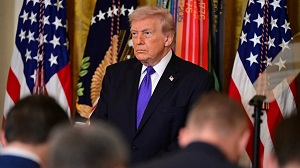 Trump has privately shown serious interest in U.S. ground troops in Iran: NBC
-
 Explosions heard in Iraq's Erbil, US-run oil field shut down
-
 King receives calls from Belgium monarch, Canada PM