- Last Update29-Jul-2026


- Tweet
-
Will Netanyahu Succeed in Igniting the War the World Fears? - By
Zaidoon Alhadid, Jordan News
I will begin with the question that dominates the current moment: Why is Benjamin Netanyahu visiting Washington, and what does he hope to secure from Donald Trump?
The man who emerged from a military confrontation with Iran without achieving his objective of ending its nuclear program understands that what Israel failed to impose through military force can only be achieved with stronger American backing.
He enters the White House carrying a single guiding principle: "Do not give Iran a chance to catch its breath."
In my view, the Israeli agenda extends well beyond the nuclear issue. It also seeks to reshape the rules of engagement in the Middle East.
Israel wants complete freedom to strike any target it considers a threat, retain buffer zones, preserve its military superiority, and most importantly secure a lasting American commitment to keep Iran under constant political, economic, and military pressure.
The problem, however, is that Netanyahu's calculations are not necessarily Washington's.
Despite Trump's tough rhetoric toward Iran, he understands that authorizing another war is not merely a military decision it is a political and economic gamble that could drag the United States into yet another regional quagmire.
Every escalation increases the cost of war, not only in terms of soldiers' lives but also through its impact on the global economy, energy markets, and international shipping.
Iran, in my opinion, is neither the collapsing state portrayed by its adversaries nor a country capable of enduring an open-ended war without paying a heavy price. Within the Iranian establishment, there is a clear divide between those who believe that rescuing the economy requires negotiations and sanctions relief, and those who view any concession as a strategic defeat.
Yet this internal division does not change one fundamental reality: when Iran's national security is at stake, the country's leadership tends to unite behind confrontation.
The more dangerous aspect of the situation is that the conflict is no longer confined to Tehran and Tel Aviv.
Any new spark would quickly spread to the Strait of Hormuz, the Red Sea, and the Bab el-Mandeb Strait critical arteries of the global economy.
This means that any military adventure could rapidly evolve into an international crisis extending far beyond the region, compelling major powers to intervene to protect their own interests before those of their allies.
Even within the United States, the debate has shifted from whether Iran should be struck to whether such a strike would achieve its objectives.
Military experts recognize that destroying nuclear facilities or infrastructure would not eliminate Iran's capabilities.
Instead, it could encourage Tehran to broaden its response, opening the door to a prolonged conflict whose outcome no one can predict.
This is where the central paradox lies, in my view. Netanyahu is trying to convince Trump that now is the right time to intensify the confrontation, while the facts on the ground suggest that this may instead be the best moment to prevent a wider explosion.
Military power can ignite wars, but it cannot always bring them to an end.
As for my own assessment of where events may be heading, I believe Netanyahu seeks a war that completes what Israel has already begun, while Trump wants to deter Iran without becoming entangled in a conflict that drains American resources.
Between these two objectives, the Middle East stands atop a powder keg, waiting for a single decision that could either reshape the region's political and security landscape for decades to come or merely postpone an even more violent confrontation in the future.
Latest News
-
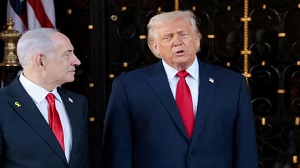 Netanyahu in Washington to Meet Trump for First Time Since Start of War with Iran
-
 Foreign minister, UN chief discuss efforts to restore regional security, stability
-
 Air Force downs two drones, no injuries or damage — JAF
-
 France and Spain battle 'unpredictable' wildfires as 300,000 evacuated
-
 Iran says halts Middle East attacks as US holds fire