- Last Update26-Mar-2026


- Tweet
-
Safadi says Jordan not party to regional conflict, urges Iran to stop aggressions
The Jordan Times
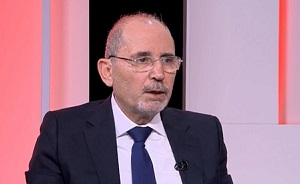
AMMAN — Deputy Prime Minister and Foreign Minister Ayman Safadi on Wednesday stressed that Jordan is not a party to the ongoing regional conflict, despite being affected by its repercussions.
In remarks to Al Mamlaka TV, Safadi said that no attacks against Iran have been launched from Jordanian territory, noting that Iran has targeted Jordan and other countries in the region.
He said that the government’s "top priority" remains the protection of the Kingdom and its citizens.
Safadi also said that Jordan has formally communicated to Iranian authorities the need to cease any targeting of the Kingdom’s territory. “We are not a party to this, and the war did not start from our side,” he said.
On the presence of foreign military forces, the minister noted that while Jordan does not host foreign "bases," allied forces operate in the country under clear defence agreements. “Jordan has never hidden the fact that there are friendly and allied forces on its soil. These arrangements have expanded since the regional war on terrorism,” Safadi said.
He emphasised that the presence of these forces does not infringe upon Jordan’s sovereignty or independent decision-making, noting that the agreements are strictly defensive in nature, with any military action requiring prior approval from Jordanian authorities.
Safadi also said that Jordan deals with regional issues in a manner that safeguards its national interests, security, stability, and the safety of its citizens.
He added that the Iranian embassy in Amman continues to operate with a chargé d’affaires and diplomatic staff, while Jordan has refused to extend the residency of one Iranian diplomat and denied accreditation to another, sending a clear signal regarding the Kingdom’s position on Iranian policies.
He also highlighted that relations with embassies are governed by political considerations, reaffirming Jordan’s ongoing commitment to regional security.
He also noted that Jordan was open to dialogue with Iran before the war, provided Tehran halted actions that threaten the security and stability of Jordan and other Arab states.
“The question of if and when to engage with the Iranian embassy in Amman is guided by political considerations, and we take the necessary steps at the appropriate time, when we deem it necessary,” Safadi said.
Safadi also revealed that Jordan has been subjected to strikes targeting the Kingdom’s territory by factions based in Iraq during recent regional tensions.
Safadi said that the government has contacted its Iraqi counterpart on several occasions to stress the necessity of stopping these aggressions and preventing their recurrence.
The minister affirmed that Jordan is handling these developments with "wisdom" and does not seek escalation, while underscoring the Kingdom’s unwavering commitment to its security and stability.
Safadi added that Jordan "highly values" its relations with Iraq, highlighting the deep-rooted brotherly ties that the Kingdom is keen to respect, strengthen, and sustain.
The foreign minister emphasised that the Iraqi government must take the necessary measures to prevent these factions from targeting Jordan and other countries in the region.
Safadi also revealed that Jordan has previously provided the Iranian side with documented evidence, facts, and information regarding practices and targets undermining the Kingdom’s security.
Safadi also said that "Iranian hands" and entities affiliated with Iran are behind ongoing attempts to smuggle drugs and weapons across the Syrian border.
He noted that Jordan has, for years, faced continuous attempts directly targeting its national security.
The minister said that the Jordanian government and security agencies have repeatedly engaged with their Iranian counterparts on the necessity of halting these practices, which pose a threat to national security, calling for them to be addressed "at the root".
Safadi noted that Jordan has informed Iran on several occasions of the importance of resolving these issues and disputes, while working to remove any obstacles preventing the establishment of sound bilateral relations.
Safadi reiterated that Jordan’s ties with Syria are at their strongest in political, security, military, and economic sectors.
He also cited the meeting with Syrian President Ahmad Al Shara, accompanied by the Chief of the Joint Staff and the Director of General Intelligence, to discuss measures against cross-border drug and arms smuggling, and the threat posed by ISIS and other terrorist groups.
Safadi said the talks also focused on boosting economic ties, noting that Jordan fully supports Syria during its critical reconstruction phase, in line with His Majesty the King’s directives.
He emphasised that Syria’s stability is key to the security of Jordan and the region, condemning Israeli attacks on Syrian territory.
Safadi also noted that preparations are underway for the second ministerial meeting of the Higher Coordination Council, with both sides committed to strengthening bilateral partnerships.
Safadi said that the complaint filed by Jordan to the United Nations regarding Iranian aggressions serves to consolidate the Kingdom’s legal rights under international law.
Safadi underscored that documenting such attacks with the UN is a "necessary procedure" when any state is subjected to aggression.
The move aims to preserve Jordan’s right to address these incidents, seek compensation for resulting damages, and uphold its inherent right to self-defence.
The minister affirmed that Jordan has documented the violations it faced, asserting its right to respond in accordance with international law and to demand reparations for any current or future damages.
Safadi noted that the Iranian response to the Jordanian complaint contained "politically incorrect" allegations and presented legal justifications he described as "null and void," particularly concerning Jordan's right to defend its territory.
Safadi also confirmed that Jordan’s border crossings remain open, highlighting the Kingdom’s role amid regional tensions.
During March, Jordan handled a significant movement of travellers from some 60 countries, totalling around 7,000 people by air and land, including 45 evacuation flights carrying European, African, and Asian nationals.
Safadi emphasised Jordan’s commitment to facilitating transit and returns in accordance with international agreements, noting that the country’s stability and strategic location make it a safe hub for evacuations.
On the matter of Jordanians abroad, he noted that some 7,000 citizens in the Gulf states have made their way to Saudi Arabia, with about 3,000 already back in the Kingdom.
Safadi stressed that Jordan is committed to containing the conflict and working to end it on a basis that safeguards against future threats in the region.
He highlighted that Jordan’s right to respond is guaranteed under Article 51 of the UN Charter, with the timing of any measures guided by the level of threat and coordinated with other countries.
Safadi added that the greatest challenge will lie in the post-conflict period, emphasising that Jordan will tackle these challenges to protect national and Arab security while working towards a stable and hopeful future.
“The Kingdom has successfully managed numerous crises in the past,” he said.
Safadi stressed that Jordan is committed to upholding its legitimate right to defend its sovereignty, highlighting that the Kingdom has consistently refrained from initiating hostilities, even as it has faced attacks linked to regional tensions.
He noted that the JAF efficiently intercepted around 240 missiles and drones, limiting the damage, adding that Jordan is continuing its efforts to restore security and stability in the region.
Safadi also said that Jordan is engaging politically with various international parties to stop the Israeli aggression on Lebanon and support the Lebanese government's efforts to exert full sovereignty over its territory.
Safadi added that the Kingdom is providing extensive humanitarian aid to Lebanon, where approximately one million internally displaced persons (IDPs) are placing a "significant burden" on the state.
Under Royal directives, Jordan has dispatched assistance to help address these urgent needs and will continue to provide support in coordination with the international community, while calling on global powers to play an active role in helping Lebanon overcome these challenges.
Latest News
-
 Safadi calls counterparts, discusses efforts to de-escalate regional tension
-
 Iran media says energy infrastructure attacked
-
 Trump calls off Iran strikes and announces 'very good' talks
-
 Lebanon PM says Iran Guards commanding Hizbollah operations in Lebanon
-
 'Point of no return' looming in Middle East war — Red Cross