- Last Update11-Aug-2026


- Tweet
-
The last Iranian cards: Militias, escalation and negotiations - By Amer Al Sabaileh, The Jordan Times
The Houthi escalation against Saudi Arabia, and reports of possible coordination between attacks launched from Yemen and Iraq at the same time, can no longer be viewed simply as a security development linked to one particular theatre. They have become part of a broader Iranian equation through which Tehran is attempting to rebuild the leverage it has lost over the past two years. The current picture is not simply about launching a missile or a drone, but about using what remains of Iran’s network of proxies as a means of improving its negotiating position and imposing a new political equation.
Iran is entering negotiations today fully aware that many of its traditional instruments of pressure have been weakened. The Lebanese front no longer possesses the same ability to impose deterrence, while Syria has, to a large extent, moved outside Iran’s direct calculations. At the same time, the American military presence in the Gulf has made the use of the Strait of Hormuz as a pressure point more costly and less effective. Tehran is therefore left with the theatres where it still retains a degree of freedom of movement, most notably Yemen and Iraq.
This is where the timing of the Houthi escalation, and the talk of possible coordination with Iraqi factions to target Saudi Arabia, can be understood. The objective is not limited to sending a security message to Riyadh. It is also intended as a negotiating message to Washington: Iran still has the ability to affect regional stability, and any understanding with Tehran cannot ignore its regional influence, even if the tools supporting that influence have been significantly reduced compared with previous years.
More importantly, however, this escalation also reflects an internal Iranian crisis that goes beyond the military dimension. As economic and social pressures deepen and the regime enters a complicated phase of political transition, parts of the power structure in Tehran increasingly view any settlement with the United States as something that could be interpreted domestically as a retreat from the regional project on which the legitimacy of the regime has rested for years. External escalation therefore becomes a means of protecting internal legitimacy, just as it becomes a tool for improving the terms of negotiation.
In this sense, the “unity of fronts” strategy is no longer being used primarily to open new battlefields. It has increasingly become a means of preserving the image of Iranian influence. Iran no longer has the capacity to manage all these theatres as it once did, but it is trying to maintain the perception that it can still activate them whenever it chooses. This explains the greater focus on Yemen, attempts to reactivate some Iraqi factions, and even the creation of new formations that give Tehran greater room for manoeuvre and greater deniability when attacks are carried out.
The problem is that continuing along this path keeps the region trapped in a cycle of escalation. Whenever the prospects for a political understanding become closer, the level of operations carried out by actors in Iran or by its proxies rises, as though these operations are part of the negotiating process itself rather than a departure from it. This is where the paradox lies: negotiations, which are supposed to reduce tensions, become a factor driving further escalation on the ground.
At the same time, regional states appear to be facing a different kind of test. The long-standing reliance on containing proxy activity through diplomacy alone has failed to change Iran’s calculations. Tehran has instead interpreted this approach as providing sufficient space to accumulate additional pressure tools whenever a negotiating pointapproaches. Any new approach, therefore, cannot separate negotiations with Iran from the future of the militias it controls. Maintaining these instruments effectively means maintaining the ability to reproduce regional crises at every new stage of negotiations.
Ultimately, militias are no longer, for Iran, primarily a project of expansion as they were in earlier phases. They have increasingly become a project for preserving the regime itself. The greater the pressure inside Tehran, the stronger the inclination to activate proxies outside it. Understanding the current escalation therefore does not begin in Sana’a or Baghdad, but inside Iran itself, where the internal struggle for power is increasingly determining the shape of escalation across the region, and turning militias into Iran’s last remaining bargaining chips.
Latest News
-
 Iran Guards say won't reopen Hormuz without US meeting all Tehran's conditions
-
 Jordan welcomes UN condemnation of Houthi attacks against Saudi Arabia, commercial shipping
-
 Jordan condemns Iranian attack on UAE tanker in Strait of Hormuz
-
 Israeli Strike on Lebanese Army Raises Tensions in South
-
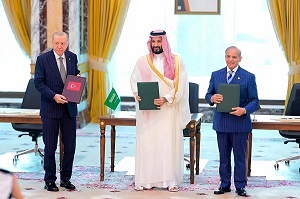 Saudi Arabia, Turkey, Pakistan sign joint defence agreement