- Last Update08-Aug-2026


- Tweet
-
Israeli Strike on Lebanese Army Raises Tensions in South
Asharq Al-Awsat
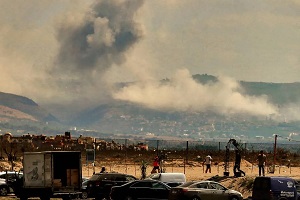
An Israeli strike on a Lebanese army bulldozer in Mansouri, wounding a soldier, heightened tensions in South Lebanon amid explosions and shelling that hit towns and water facilities.
The escalation coincided with fallout from the seventh round of Rome talks, which ended without agreement on expanding pilot zones. Khiam and Bint Jbeil remain outside the plan after Israel rejected Lebanon’s proposal for the two areas, bringing the issue of an Israeli withdrawal from both towns back to the fore.
The Lebanese army announced that a soldier sustained minor injuries in an “Israeli enemy attack” on a military bulldozer clearing roads and rubble in Mansouri, in the Tyre district.
Explosions also rocked Qounine and Wadi al-Hujair, while artillery fire struck Hadatha, setting several homes ablaze, and Wadi Zibqin. A drone raid hit Mayfadoun. Mansouri also came under artillery fire and four stun grenades before an Israeli drone later struck the town.
Water infrastructure was also affected. Israeli forces set fire to the Wadi al-Slouqi water station near the Shaqra junction. The South Lebanon Water Establishment reported that the head of its Bint Jbeil department and several workers came under Israeli fire in Aita al-Jabal while repairing faults to restore water supplies. It condemned the incident as “an attack on civilians and residents’ right to access water” and vowed to continue its work despite the risks.
Artillery shelling and machine-gun fire were recorded in Mais al-Jabal, while Israeli vehicles briefly advanced on the outskirts of Hadatha and Aita al-Jabal before withdrawing.
Strike on Lebanese Army
Retired Brig. Gen. Khalil Helou viewed the Mansouri incident as carrying significance beyond an isolated battlefield episode.
“In previous incidents, such as what happened in Zawtar, Israel claimed the Lebanese army had approached areas where there had been no coordination,” Helou told Asharq Al-Awsat. “What happened in Mansouri, however, is a message to the army.”
He placed the explosions in Wadi al-Hujair, Qounine and elsewhere within what he described as Israel’s effort to destroy homes and facilities it believes Hezbollah could use in the future.
Helou ruled out an Israeli withdrawal from Bint Jbeil or Khiam in the near term. He explained that the issue of Bint Jbeil had been raised during the first meetings in Washington but met with outright Israeli rejection because the area lies within the “yellow line.”
He added that available information suggests that the current Israeli government will make no concessions within that line before elections.
Helou attributed the stance to military, security and electoral considerations, arguing that any concession could be portrayed domestically as weakness, particularly following the recent deaths of Israelis. Bint Jbeil and Khiam also carry particular military symbolism for Israel after heavy Israeli losses there during the 2006 war and recent fighting.
Washington, he added, is exerting considerable pressure on Israel to make concessions and strongly backed the Lebanese delegation during the Rome talks. But US leverage becomes limited when Israel invokes security concerns, “whether for Trump or anyone else.”
Israeli Restrictions
Retired Brig. Gen. Bassam Yassin linked the Mansouri strike to Israel’s treatment of the entire territory under its control as a military zone off-limits to Lebanese troops and civilians, an approach he believes also explains its refusal to withdraw from Khiam and Bint Jbeil.
“After the Majdal Zoun explosion, Israel threatened Mansouri and demanded that the army and civilians evacuate,” Yassin told Asharq Al-Awsat. “When the army tried to return, the area was treated as a military zone where approaching was prohibited. Today, when a bulldozer moved in to work, it was struck.”
Yassin argued that Israel has no intention of leaving Khiam or Bint Jbeil at this stage. In Khiam, he pointed to a military base established near the former detention center, while an Israeli withdrawal from Bint Jbeil would be highly unlikely before a final settlement, “if there is a withdrawal at all.”
He further explained that Israel’s interest extends beyond Bint Jbeil itself to an area stretching from the elevated town of Beit Yahoun toward Bint Jbeil, including Qounine, Hadatha and surrounding localities. Israel, he argued, wants to retain positions that protect its forces farther behind.
Yassin concluded that Israel appears unwilling even to leave the yellow zone. Changing that reality would require “a comprehensive settlement and significant US pressure”; otherwise, the occupation could become a long-term reality, he warned.
Lebanon Documents Violations
Separately, President Joseph Aoun received from Deputy Prime Minister Tarek Mitri a 232-page report by the National Commission for International Humanitarian Law documenting serious Israeli violations during the latest war.
The report contains documents and photographs covering attacks on bridges, crossings, residential apartments, medical facilities, paramedics, civil defense personnel, the Lebanese Red Cross, journalists and other civilian targets. It also addresses the forced displacement of civilians and damage to hospitals, cultural property and other sites.
Aoun and Mitri also discussed an international initiative to renew commitment to international humanitarian law and a summit scheduled for December in Amman, organized by the International Committee of the Red Cross under the auspices of several Arab and foreign heads of state.
Latest News
-
 Jordan condemns terrorist bombing targeting passenger minibus in Syria
-
 Foreign minister, Yemeni counterpart discuss cooperation
-
 Prince Ali says FIFA releases Jordan's overdue Arab Cup prize money
-
 King calls for unified Arab-Muslim stance, joint effort to halt Israel’s unprecedented violations in Jerusalem
-
 Jordan, Arab, Islamic states condemn Israeli actions in Jerusalem, call for int’l intervention