- Last Update03-Jun-2026


- Tweet
-
Trump says Iran talks happening 'continuously'
AFP
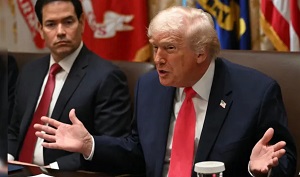
WASHINGTON, United States — President Donald Trump said Tuesday that the United States and Iran were speaking "continuously," denying reports that Tehran had broken off contact over Israel's attacks on Lebanon.
Trump added that "one never knows" where the negotiations would lead, as weeks of direct and indirect talks have failed to end the US-Israeli war on Iran that began on February 28.
"Fake News Reports that the Islamic Republic of Iran, and the U.S.A., stopped speaking a few days ago are false and erroneous," Trump said on his Truth Social network.
"The conversations between us have been going on continuously, including four days ago, three days ago, two days ago, one day ago, and today."
Trump added: "Where they lead, one never knows, but as I told Iran, 'It's time, one way or another, for you to make a Deal. You've been doing this for 47 years, and it cannot be allowed to go on any longer!'"
Trump said on Monday that Iran talks were moving at a "rapid pace".
Iran's Tasnim news agency reported Tehran had suspended dialogue with mediators in protest at Israel's expanding offensive in Lebanon..
"Talks are continuing, at a rapid pace, with the Islamic Republic of Iran," Trump said in a social media post made shortly after another post in which he said he had persuaded Israel and Iran-backed Hizbollah to de-escalate.
Weeks of indirect talks between the US and Iran marked by threats and several waves of air strikes have so far failed to bring about an end to the war or the reopening of the Strait of Hormuz.
Secretary of State Marco Rubio on Tuesday expressed hope that a deal to end the war in Iran was in the cards, stressing that Tehran must severely curtail its nuclear program before any sanctions are lifted.
"There is the prospect before us, which could happen today, it could happen tomorrow, it could happen next week," Rubio told a Congressional panel.
Rubio was testifying in front of the Senate Foreign Relations Committee, as the three-month US-Israeli war on Iran appears to have reached an impasse, with the closure of the strategic Strait of Hormuz continuing to disrupt global energy markets.
Rubio insisted that Tehran must reopen the shipping channel for any peace agreement to take hold, while also agreeing to curb its nuclear activities in order to see sanctions lifted.
"Iran is being sanctioned because they've highly enriched uranium, Iran is being sanctioned because of their nuclear activities," Rubio said. "If they agree to give up those things, there will be sanctions relief."
Trump has repeatedly expressed confidence that a deal with Iran was near, but talks have stalled. And although a ceasefire has largely held since early April, Iranian and US forces have traded strikes in recent days.
Rubio sought to downplay the hostilities, saying the conflict had effectively ended. "Well, the war is over," he said.
While acknowledging that the Iranians "still have a lot of drones," Rubio defended the decision to go to war, saying it has significantly reduced the Islamic republic's ability to do harm.
"Iran has no navy left, they've lost a substantial percentage of their defense industrial base, that Iran has lost a substantial percentage of their missile launchers," Rubio said.
He added: "And their economy is far worse today, and I mean, far worse today than it was six to nine months ago."
Rubio also stated that Iran's supreme leader Mojtaba Khamenei, who was wounded in US-Israeli attacks and has not been seen in public since assuming office, is alive and increasingly active.
"I think there are indications out there that he is increasingly engaging at some level," Rubio told the panel.
Mojtaba Khamenei, 56, succeeded his father Ali Khamenei, who was killed in the first wave of US-Israeli strikes that launched the war on February 28.
Latest News
-
 Trump says Iran truce talks moving at 'rapid pace' after Tehran threats
-
 US says struck Iranian radar and drone control sites
-
 Labour minister urges private sector to support World Cup work-hour adjustment
-
 Jordan condemns Iranian ‘repeated’ attacks on Kuwait
-
 King inaugurates Arab Potash, Jordan Bromine vital projects in Ghor Al Safi