- Last Update18-Sep-2026


- Tweet
-
Jordan and the international shift: From condemning the occupation to protecting the Palestinian State - By Hasan Dajah, The Jordan Times
Israel faces a political moment where the gap is widening between its ability to impose facts on the ground by force and its ability to convince the world of the legitimacy of its actions. The humanitarian tragedy in Gaza, alongside the dangers of killing, displacement, and settlement expansion in the West Bank, is subjecting Western governments to an increasingly rigorous test of their credibility. At the heart of this landscape, Jordanian diplomacy, led by His Majesty King Abdullah, is gaining heightened significance, as growing international stances align with the Jordanian vision that links regional security to ending the occupation and establishing an independent Palestinian state.
The discussion regarding this shift in public opinion is not based on impressions alone. A Pew Research Center poll published in April 2026 revealed that 60 per cent of Americans view Israel negatively, up from approximately 53 per cent the previous year. These results reflect a tangible decline in Israel’s image among its key allies-though this does not automatically imply that all respondents support a single policy regarding the conflict. Nevertheless, the findings reveal that continued political support is now contending with a public environment that is increasingly critical and demanding of accountability.
A joint statement issued on September 8, 2026, by the foreign ministers of twelve nations-Britain, France, Canada, Denmark, Finland, Iceland, Ireland, Norway, Poland, Portugal, Spain, and Sweden-has given significant diplomatic expression to this shift. The statement focused on the deteriorating situation in the West Bank, the escalation of settler violence, and settlement expansion, warning against undermining the two-state solution and rejecting the annexation of Palestinian territory and the forced displacement of its inhabitants.
The statement is particularly significant for its shift toward economic tools; the participating nations announced their intention to implement national restrictions-or support European ones-on trade in settlement goods, or to seriously consider such measures in accordance with their domestic laws. Britain, France, and Canada confirmed they would introduce measures to ban trade in these goods. This distinction is crucial, as the announcement does not imply the immediate implementation of a unified ban across all these countries; nevertheless, it opens the door to linking political opposition with economic costs that directly impact the settlement enterprise.
The danger of the situation in the West Bank lies in the fact that the accumulation of daily realities could determine the future of the cause before any negotiations even begin. Every Palestinian community that loses the means of its survival, and every tract of land carved out for settlements, makes the establishment of a contiguous, viable state increasingly difficult. Consequently, protecting the population from killing and displacement becomes both a humanitarian and political imperative, and halting settlement expansion becomes a prerequisite for safeguarding the land upon which a settlement is meant to be built-and for ensuring its inhabitants can remain there.
As for Gaza, the scale of the tragedy dictates that protecting civilians, providing relief and rebuilding lives be treated as an urgent responsibility. Sustainable peace cannot be achieved by politically separating the Strip from the West Bank or by turning reconstruction into a vehicle for displacing the population from their homeland. Humanitarian efforts must lead to the restoration of rights and the ability to sustain life within a unified Palestinian political framework, ensuring that crisis management does not become a permanent substitute for addressing the root causes of the catastrophe.
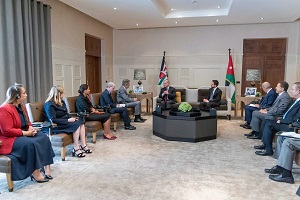
In this context, the importance of Jordanian royal diplomacy in keeping the Palestinian cause at the forefront of regional and international attention is evident. During his discussions with UAE President Sheikh Mohamed bin Zayed Al Nahyan in Abu Dhabi on September 13 His Majesty warned of the dangers posed by Israeli measures aimed at annexing territory and expanding settlements in the West Bank, as well as violations affecting Islamic and Christian holy sites in Jerusalem.
The two leaders affirmed their commitment to continued coordination and consultation to foster security, stability, and peace in the region. This move reflects Jordan’s recognition that safeguarding prospects for a settlement requires confronting actions that undermine it on the ground, and transforming Arab and international rapprochement into effective pressure that protects Palestinian rights and preserves the possibility of establishing an independent state.
The strength of Jordan’s position stems from its direct link to the region’s interests and security. Displacement threatens the Palestinian people in their homeland while simultaneously opening the door to instability that transcends borders. Consequently, defending the Palestinians' continued presence on their land is tantamount to defending regional stability.
Furthermore, protecting Jerusalem and its Islamic and Christian holy sites, under the Hashemite Custodianship, imbues Jordan’s efforts with historical and moral significance, underscoring the necessity of preserving the city’s identity and the rights of its inhabitants within any just settlement.
Nevertheless, the global shift must be viewed realistically. A decline in Israel’s international image does not equate to the collapse of its alliances, and Western statements alone cannot guarantee an end to violations. Moreover, growing support for the two-state solution requires measures that safeguard the feasibility of its implementation. This highlights the importance of coordination-between Jordan, Arab nations, and states willing to act-to forge a cohesive stance that demands civilian protection, accountability for perpetrators of aggression, an end to support for settlements, and practical guarantees to prevent the continued erosion of the foundations of a future Palestinian state.
The current phase also demands support for Palestinian institutions, strengthening their capacity to deliver services and shielding the local economy from collapse. People’s resilience relies on access to schools, hospitals, and employment opportunities, as well as freedom of access to their land and livelihoods. Nations supporting a settlement must incorporate these requirements into their policies and match their recognition of rights with concrete steps to uphold them.
Any delay only widens the gap between the state the world theoretically supports and the increasingly complex reality on the ground. The opportunity available today lies in translating the convergence between the Jordanian visions and shifting international stances into tangible results that enhance the security and freedom of the Palestinian people.
The ultimate measure of success remains halting the killing and displacement, protecting Jerusalem, preserving the unity of Palestinian territory, and opening a serious path toward an independent, sovereign state. Only then can this global shift serve as a springboard for a just peace and diplomacy transform from a voice warning of catastrophe into a force that helps avert it and shape a different future.
Hasan Dajah is professor of strategic studies at Al-Hussein Bin Talal University