- Last Update21-Aug-2026


- Tweet
-
Jordanian-Chinese relations: A partnership for the future - By Hasan Dajah, The Jordan Times
The visit of His Majesty King Abdullah to the People's Republic of China marks a significant milestone in the trajectory of Jordanian-Chinese relations. It sends a clear message that royal diplomacy is confidently moving toward diversifying international partnerships and linking political ties with tangible economic and developmental interests.
The visit takes place more than a decade after the establishment of the strategic partnership between the two nations in 2015 and shortly before the 2027 commemoration of the fiftieth anniversary of diplomatic relations; this lends the visit historical significance and offers an opportunity to formulate a new cooperation agenda for the coming decade.
Politically, the visit underscores the depth of mutual trust and the commitment of both leaderships to consult on regional and international issues.
Under His Majesty’s leadership, Jordan pursues a balanced foreign policy rooted in dialogue, moderation, and respect for international law, while China stands as an influential global power and a permanent member of the UN Security Council.
This alignment facilitates enhanced coordination to bolster security and stability in the Middle East, halt cycles of escalation, and drive political solutions to crises.
The Palestinian issue also remains a central focus; Jordan continues to champion the two-state solution-advocating for an independent Palestinian state based on the June 4, 1967 lines with East Jerusalem as its capital, while upholding the Hashemite Custodianship over Islamic and Christian holy sites in Jerusalem-whereas China can leverage its international standing to support a just peace and expand the humanitarian response in Gaza.
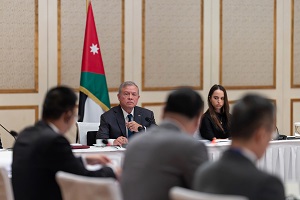
Economically, the visit paves the way for a transition from mere growth in trade and investment toward the establishment of long-term, productive partnerships. His Majesty presented the advantages of Jordan to CEOs of major Chinese companies, highlighting-above all-stability, a strategic location linking Asia, Africa, and Europe, skilled human capital, natural resources, and a network of free trade agreements providing access to vast markets.
This positions the Kingdom not merely as a consumer market, but as a hub for manufacturing, services, and exports-capable of hosting Chinese investments in pharmaceuticals, food processing, engineering, agriculture, aviation, mining, logistics, and e-commerce.
These opportunities align with Jordan’s Economic Modernization Vision and China’s Belt and Road Initiative and Global AI Governance Initiative.
Jordan can leverage these frameworks to develop infrastructure, industrial zones, supply chains, transport, and energy sectors, while ensuring projects are sustainable and capable of creating jobs, transferring knowledge, and boosting exports.
Furthermore, existing Chinese investments in potash, energy, and infrastructure provide a foundation upon which to launch joint ventures offering higher value-added returns.
The technology sector represents one of the visit's most promising avenues. His Majesty’s visit to the Shanghai-based company "AgiBot" demonstrated a direct interest in robotics applications across industry, logistics, hospitality, and security, with an emphasis on fostering collaboration between the company and Jordanian universities and institutions. This interest could be translated into a Jordanian-Chinese robotics center, joint R&D laboratories, engineering training programs, and startup incubators-ultimately leading to the local assembly, component manufacturing, programming, and maintenance of robots. In this way, Jordan would become a partner in technology production and a regional hub for exporting smart solutions, rather than merely an importer of them.
Regarding green energy, such cooperation aligns with Jordan’s drive to increase the share of renewable energy and to develop storage systems, smart grids, and green hydrogen.
Chinese companies possess extensive expertise in solar energy, batteries, and electric vehicles, while Jordan offers natural resources, suitable locations, legislative stability, and investment opportunities.
Well-planned partnerships would bolster energy security, reduce production costs, enhance the competitiveness of national industry, and link economic growth to a path of sustainability.
Education and culture form an essential foundation for a sustainable relationship. Cooperation in teacher and staff training, language instruction (Chinese and Arabic), student and researcher exchanges, and the establishment of joint research centers expands mutual understanding and transforms official ties into deep-rooted human connections. Jordanian and Chinese universities can develop dual-degree programs in fields such as artificial intelligence, engineering, medicine, and energy, alongside joint research grants, thereby preparing a generation capable of managing and advancing new investments.
Cooperation in health and public administration is equally significant; capacity-building programs can be expanded, and Chinese expertise leveraged in areas such as smart hospitals, telemedicine, pharmaceuticals, and medical devices. Furthermore, Jordanian institutions can collaborate with Chinese partners-within established data protection and privacy frameworks-to develop digital solutions for government services, cybersecurity, and smart cities. Such initiatives would improve service quality, enhance spending efficiency, open markets for innovative Jordanian companies, and strengthen the Kingdom’s resilience in facing health and economic crises.
Regarding tourism and culture, His Majesty’smeeting with the Trip Group highlighted opportunities for the smart marketing of Jordanian sites, increasing Chinese tourist numbers, improving air connectivity, and integrating heritage into tourism events and experiences.
Jordan boasts a unique tourism product-encompassing Petra, Wadi Rum, the Dead Sea, the Baptism Site, and Jerash-and digital cooperation and film production can showcase this more widely to the Chinese market, thereby extending visitor stays and spreading economic benefits to local communities.
There is hope that these understandings will be translated into concrete implementation programs-comprising clear agreements, timelines, performance indicators, funding, and partnerships involving governments, the private sector, and universities.
If both parties effectively build upon this momentum, the visit will pave the way for a new phase in which relations shift from traditional cooperation to productive and knowledge-based integration.
This visit reinforces Jordan’s position as a bridge between China and the region, opens up new opportunities for the national economy, and affirms that a partnership grounded in mutual respect and benefit can effectively serve development, prosperity, and peace.
Hasan Dajah is professor of Strategic Studies, Al-Hussein Bin Talal University
Latest News
-
 King meets with CEOs of leading Chinese companies in Shanghai
-
 Chinese companies eye expanded pharmaceutical, food partnerships with Jordan
-
 Crown Prince, Princess Rajwa receive top Tawjihi achievers
-
 King interviewed by China’s Xinhua News Agency
-
 Yemen risks return to 'full-scale conflict', warns UN rights chief