- Last Update20-May-2026


- Tweet
-
Gov’t bans entry from DRC, Uganda over Ebola concerns
AFP
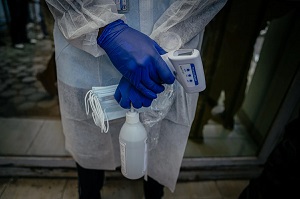
AMMAN — The government has imposed a ban on arrivals from the Democratic Republic of the Congo (DRC) and Uganda as a precautionary measure to safeguard the Kingdom from the spread of Ebola, National Centre for Epidemiological and Communicable Disease Control President Adel Belbaisi said on Tuesday.
Belbaisi told Al Mamlaka TV that the decision aims to preserve Jordan’s Ebola-free status following an assessment of epidemiological data related to outbreaks in both countries.
He said that Jordanian citizens currently in the DRC or Uganda will still be allowed to return home but will be required to undergo a 21-day quarantine, the maximum incubation period for Ebola.
The quarantine may take place in designated facilities or at home, depending on each individual’s circumstances and ability to isolate safely, he said.
The move comes amid growing international concern over the outbreak. The World Health Organisation (WHO) on Tuesday warned about the “scale and speed” of the Ebola flare-up in the DRC, cautioning that the outbreak could persist for an extended period, according to AFP.
Belbaisi said the decision followed directives from the minister of health and was finalised during a meeting involving officials from the Ministry of Health, the Directorate of Epidemiology, the National Centre for Epidemiological and Communicable Disease Control and a representative from the WHO office in Jordan.
The meeting reviewed data provided by the WHO and authorities in the DRC and Uganda, indicating a significant spread of the virus in both countries. According to Belbaisi, approximately 131 suspected deaths and more than 500 confirmed and suspected cases have been recorded.
He noted that the recommendation was submitted to the minister of health and later approved by the Prime Ministry as part of efforts to protect public health in the Kingdom.
Belbaisi added that the entry ban will be reviewed monthly in light of updated epidemiological data and could either be extended or lifted depending on the progression of the outbreak.
Explaining the nature of the disease, Belbaisi said Ebola is a severe haemorrhagic fever virus initially transmitted to humans through contact with infected fruit bats and later spread through blood, bodily fluids and contaminated surfaces.
He stressed that Ebola does not spread in the same manner as COVID-19 and is unlikely to trigger a global pandemic, although it remains highly dangerous because of its elevated mortality rate.
Belbaisi also urged anyone experiencing unexplained fever after visiting affected areas or coming into contact with suspected or confirmed cases within the previous 21 days to seek immediate medical attention and disclose their travel history.
He affirmed that Jordan possesses the laboratory capacity needed to detect the virus, with testing kits available at the Ministry of Health’s central laboratories and the National Centre for Epidemiological and Communicable Disease Control.
Belbaisi reassured the public that there is no cause for panic.
WHO on Wednesday said the risk of the Democratic Republic of Congo's deadly Ebola outbreak was currently high at the national and regional levels but low worldwide.
WHO experts said that while investigations into its origins were ongoing, given the scale of the situation in the eastern DRC, the outbreak probably began a couple of months ago, according to AFP.
But the UN health agency's emergency committee said it did not currently meet the pandemic emergency threshold.
"WHO assesses the risk of the epidemic as high at the national and regional levels, and low at the global level," said the organisation's chief Tedros Adhanom Ghebreyesus.
So far, 51 cases have been confirmed in the DRC, in the eastern provinces of Ituri and North Kivu, "although we know the scale of the epidemic in DRC is much larger", he told a press conference at the WHO's headquarters in Geneva.
He said Uganda had also reported two confirmed cases in the capital Kampala, including one death, while a US national working in the DRC has been confirmed positive and transferred to Germany.
"There are several factors that warrant serious concern about the potential for further spread and further deaths," said Tedros.
"Beyond the confirmed cases, there are almost 600 suspected cases and 139 suspected deaths.
"We expect those numbers to keep increasing, given the amount of time the virus was circulating before the outbreak was detected."
Not a pandemic
On Sunday, Tedros declared the situation to be a public health emergency of international concern -- the second-highest level of alarm under the legally binding International Health Regulations (IHR) -- triggering emergency responses in countries worldwide.
The WHO emergency committee convened to assess the outbreak met on Tuesday.
"The current situation and criteria for a public health emergency of international concern have been met, and we agree that the current situation does not satisfy the criteria for a pandemic emergency," the committee's chair, Lucille Blumberg, told reporters from South Africa.
Anais Legand, WHO technical officer on viral haemorrhagic fevers, said investigations were under way to pinpoint how long Ebola has been spreading in the eastern DRC.
"Given the scale, we are thinking that it has started probably a couple of months ago, but investigations are ongoing and our priority is really to cut the transmission chain by implementing contact tracing, isolating and caring for all suspect and confirmed cases," she said.
US Secretary of State Marco Rubio on Tuesday said the WHO was “a little late" in identifying a deadly outbreak.
Latest News
-
 King inaugurates Baptism Site International Orthodox University
-
 King sees off families of martyrs leaving to perform Hajj
-
 Trump issues dire warning to Iran to accept peace deal
-
 King receives Australia defence minister
-
 Crown Prince, Princess Rajwa attend artificial intelligence session at Tawasol 2026 forum