- Last Update22-Jun-2026


- Tweet
-
US-Iran negotiation under conditions of conflict - By Amer Al Sabaileh, The Jordan Times
The memorandum between the United States and Iran, initiating a sixty-day negotiation track, does not signal the beginning of a conventional diplomatic process as much as it exposes the fragility of the entire framework meant to sustain it. The early indicators, beginning with an electronic signature rather than a direct political encounter, followed by the postponement of technical talks originally scheduled in Switzerland, suggest that what is unfolding is not a procedural delay, but a reflection of unresolved strategic contradictions at the core of the relationship.
On the Iranian side, the message attributed to the Supreme Leader, who is more often referenced than directly heard, serves to delineate the boundaries of political responsibility rather than to endorse the process itself. The conservative establishment deliberately positioned the burden of negotiation on President Masoud Pezeshkian and his team, reaffirming that while the Supreme Leader maintains a different strategic reading, he trusts the delegation not to compromise core national interests. In doing so, the conservative current preserves the ideological architecture built on decades of adversarial positioning toward the United States, ensuring that negotiations remain framed as an act of necessity rather than doctrinal revision.
This internal balancing act allows the Iranian establishment to separate political functionality from ideological legitimacy. Negotiation becomes a tactical instrument of state survival, not a shift in identity. Within this logic, the invocation of historical-religious symbolism, such as the attributed phrase of Imam Hussein rejecting allegiance to Yazid ibn Muawiya, is not incidental, but part of a broader effort to reinforce the distinction between coercive political necessity and preserved ideological purity.
Yet this duality is not confined to Tehran. In Washington, the same structural divergence is increasingly visible. President Donald Trump’s insistence on a sixty-day negotiation window has elevated Vice President J.D. Vance as a visible advocate of diplomatic engagement. However, this position remains far from institutional consensus. Key nodes of the American security architecture, including the intelligence community, the Department of Defence, the National Security Council, and the Treasury Department, appear more inclined toward containment logic than negotiated accommodation. Their influence is likely to expand as the process encounters operational friction.
Regionally, Israel remains the decisive variable shaping the limits of any diplomatic trajectory. The escalation in Lebanon, framed by Tehran as evidence of instability, introduces an additional layer of pressure on Washington. Yet any American attempt to constrain Israeli operational behaviour is likely to remain temporary and tactical, particularly in light of the emerging international convergence around the Lebanese state as the sole legitimate actor and the parallel push toward disarmament of Hezbollah under international sponsorship frameworks. In practice, however, Israel continues to operate under an autonomous security doctrine that prioritizes direct action over negotiated restraint.
Statements regarding a possible Syrian role, attributed to President Trump, reflect less a coherent geopolitical design than a recurring tendency to compress complex regional structures into simplified transactional concepts. Israeli strategic messaging, by contrast, has been far more explicit: security will remain self-defined, self-executed, and independent of any regional intermediary role, including Syria.
Even in the event of a temporary de-escalation in Lebanon, the regional system does not move toward stabilization but toward displacement of tensions. Alternative arenas, ranging from the West Bank and Jerusalem to the Syrian theatre, including contested constructs such as the “Druze entity” or the “David Corridor”, remain structurally available as activated pressure points should the Iranian–Hezbollah axis be partially contained.
Despite this multi-layered volatility, direct negotiations with Iran remain, at least in the short term, the only available mechanism for managing escalation risks, securing maritime flows through the Strait of Hormuz, and addressing the uranium enrichment issue. Yet the American objective extends beyond nuclear containment toward a broader architecture of political and financial constraint, encompassing frozen assets, sanctions calibration, and conditional reintegration mechanisms.
For Tehran, however, the real threshold lies not in external concessions alone but in their internal consequences. Any negotiated adjustment risks recalibrating the balance of power within the state itself, reshaping institutional hierarchies and redistributing authority between competing centres of power. As a result, each negotiation cycle is likely to function not as a step toward closure, but as a potential ignition point; between Washington and Tehran, within each capital, and across a region entering a phase of structural redefinition rather than temporary stabilisation.
Latest News
-
 Hormuz closure, Lebanon fighting threaten Iran-US deal
-
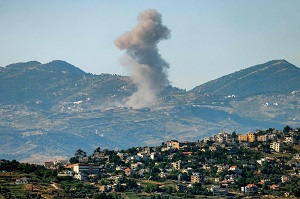 Lebanon state media says five dead in fresh Israeli strikes on south
-
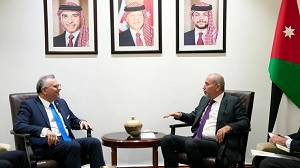 Safadi, US president's advisor discuss regional developments
-
 Hormuz ship crossings spike after war deal - trackers
-
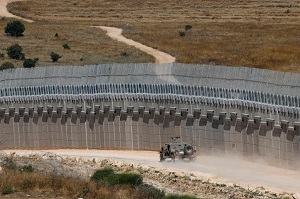 Israel, Hizbollah agree ceasefire as US-Iran deal under strain