- Last Update14-Mar-2026


- Tweet
-
Strait of Hormuz emerges as key pressure point in widening Iran war
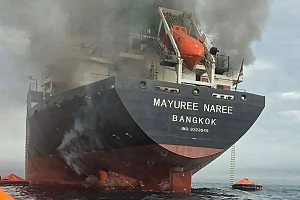
AFP
AMMAN — The Strait of Hormuz has become a central pressure point in the widening confrontation involving Iran, Israel and the United States, raising global concern over the security of the world’s most important energy corridor.
The concern comes as escalating military exchanges across the region raise fears the confrontation could spill into key maritime routes in the Gulf.
The escalation follows a wave of US-Israeli strikes on Iranian targets and Tehran’s retaliatory attacks across the region, heightening concerns that the conflict could extend to strategic energy routes.
The narrow waterway lies between Iran and Oman and connects the Gulf to the Arabian Sea and the wider Indian Ocean. Despite its limited width, it carries enormous strategic weight in the global economy.
Iranian strikes have all but halted maritime traffic in the Strait of Hormuz -- through which a fifth of global crude oil and liquefied natural gas normally pass -- and have also impacted oil infrastructure in other Gulf states.
Nearly one fifth of the world’s oil supply, about 17 million barrels per day, passes through the corridor, according to energy industry estimates. Tankers carrying exports from Saudi Arabia, Iraq, Kuwait, Qatar and the United Arab Emirates must cross the passage before reaching global markets.
Asian economies including China, India, Japan and South Korea rely heavily on these shipments, while European markets also depend on Gulf oil and liquefied natural gas transported through the route.
Such concentration of energy flows means even limited disruption in the strait could quickly reverberate across global markets.
The corridor has long been a focal point of geopolitical tension.
Iran has repeatedly warned it could disrupt shipping through the strait if its oil exports were targeted or if confrontation with the United States escalated.
Washington maintains a strong naval presence in the Gulf to ensure freedom of navigation and deter attacks on commercial shipping.
Political analyst Amer Sabaileh said that Iran has long viewed the strait as a strategic pressure tool tied to global energy markets and international politics.
“Iran believed this was a card it could continue to use, linked to international politics, shipping, oil prices and energy flows,” Sabaileh told The Jordan Times.
“But it appears the United States recognises this as one of the tools Iran relied on and has begun working to neutralise.”
Sabaileh pointed to recent developments, including US movements around Kharg Island and the deployment of specialised Marine units to secure key maritime areas, as indications that Washington is seeking to reduce Iran’s leverage over the strait.
“Using this card could ultimately backfire on Iran,” he said. “It risks turning international positions against Tehran and accelerating efforts to form a coalition to secure the strait.”
President Donald Trump said Friday that the United States had heavily bombed military targets on Iran's oil hub Kharg Island and the US Navy would soon begin escorting tankers through the Strait of Hormuz.
In a post on Truth Social, Trump said military targets on Kharg Island, which handles almost all of Iran's crude exports, had been "totally obliterated" in "one of the most powerful bombing raids in the History of the Middle East."
He said he had chosen not to target oil infrastructure on the island for now, according to AFP.
"However, should Iran, or anyone else, do anything to interfere with the Free and Safe Passage of Ships through the Strait of Hormuz, I will immediately reconsider this decision," the US president said.
Trump said the US Navy would start escorting tankers through the Strait of Hormuz "very soon", but governments around the world fear a prolonged blow to their economies with crude oil prices up more than 40 per cent since the war began.
In remarks to The Jordan Times, economic expert Musa Saket, a board member at the Amman Chamber of Industry, said that even temporary disruption to navigation could send shockwaves through global energy markets.
“Any disruption to navigation in the Strait of Hormuz, even if temporary, would quickly affect global energy markets,” Saket said.
He noted that oil prices could rise sharply depending on the scale and duration of any disruption, while shipping and maritime insurance costs would also increase.
For Jordan, the consequences would likely appear through higher energy import costs and additional pressure on the trade balance, given the Kingdom’s reliance on imported energy.
Even without a full closure, analysts say that the Strait of Hormuz remains one of the world’s most sensitive geopolitical chokepoints, where any escalation can quickly ripple through global energy markets and reshape the international response to the widening Iran conflict.
Oil prices stayed over $100 per barrel Friday while stock markets slid, with no end in sight to disruption in crude supplies as war rages on in the Middle East.
The price of Brent crude, the benchmark international oil contract, dipped below $100 during the day, sending equities briefly higher.
But stocks slid back into the red as Brent climbed back above the $100 mark.
It closed at $103.14 per barrel, and has soared by more than 42 percent since the start of the conflict.
Latest News
-
 US says Iran campaign cost $11 billion in six days - New York Times
-
 Trump says US destroying Iranian minelaying boats
-
 Israel strikes central Beirut as Lebanon death toll tops 630
-
 King, Lebanon president discuss regional developments
-
 Crown Prince meets with fifth cohort of Al Hussein Fellowship programme