- Last Update02-Mar-2026


- Tweet
-
ASE now among world’s top-performing markets, thanks to 'deep' reforms, 'strong' corporate earnings — CEO
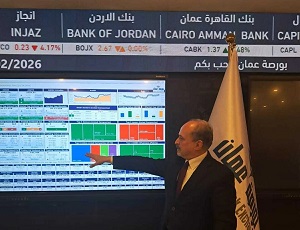
AMMAN — Chief Executive Officer of the Amman Stock Exchange (ASE) Mazen Wathaifi has recently outlined the key drivers behind the bourse’s "remarkable" performance, which recently placed it among the world’s top-performing markets, ranking 13th globally and first in the region, according to Bloomberg.
In a wide-ranging interview with The Jordan Times, Wathaifi said, “We are proud of this achievement which is the result of cumulative reforms, strong corporate earnings and improving macroeconomic fundamentals.
According to Wathaifi, the ASE’s performance reflects years of modernisation aligned with international legislative, regulatory and technical standards.
“We launched a comprehensive guidance report to reform the regulatory framework and policies governing the market, and Jordan became fifth globally in reporting compliance with the International Financial Reporting Standards Foundation (IFRS),” he noted.
Market institutions, including clearing, settlement and securities depository systems, are undergoing continuous upgrades to enhance transfer security, transparency and investor protection.
“This positive sentiment did not come from one decision alone. It is the result of sustained efforts over several years."
Government stimulus, citizenship-by-investment reform
A major liquidity boost came through amendments to Jordan’s citizenship-by-investment programme. Non-Jordanian investors may obtain citizenship in exchange for investing approximately JD1 million in listed shares.
"Previously, investments were frozen for three years. Under the revised mechanism, investors may trade their holdings during that period, provided the funds remain within the market."
“This step significantly strengthened liquidity. Instead of capital being immobilised, it now circulates within a regulated framework."
Additional government measures, including maintaining attractive investment bonds and exempting investment funds from taxes, further reinforced market optimism, he said.
“There is clear and ongoing coordination with the government. We see strong support and genuine interest in promoting investment and removing obstacles."
Internally, the ASE extended daily trading hours from two to three hours and reduced minimum and maximum brokerage commissions, lowering overall trading costs.
“These steps made trading more attractive and accessible."
Digitalisation remains central to the exchange’s strategy. The ASE adopted advanced international e-trading systems and upgraded its electronic disclosure platform to align with the latest global reporting standards.
He said that three months ago, the exchange launched the “Bursa” mobile application, enabling investors to monitor trading sessions in real time and access e-disclosures instantly.
“Disclosure updates are a continuous process. Transparency and accessibility are fundamental to investor confidence."
Strong macroeconomic indicators
At the macroeconomic level, improving fundamentals reinforced the market’s upward trajectory.
Remittances increased by 4.5 per cent, tourism revenues improved and foreign investment flows strengthened. Foreign reserves at the Central Bank of Jordan reached $28.5 billion, covering around 10 months of imports.
Public debt revenues are increasingly directed towards capital expenditures, ensuring financing supports infrastructure and development projects rather than recurrent spending.
Jordan continues to meet targets under its reform programme with the International Monetary Fund, while rating agencies including Standard & Poor's, Moody's and Capital Intelligence maintain positive outlooks on the Kingdom, he said.
“All these indicators supported the positive trend in the stock market over the past year,” Wathaifi said.
Preliminary data show that listed companies recorded JD2.36 billion in net after-tax profits, marking a 14 per cent increase compared with 2024, among the highest profit levels historically achieved.
Corporate supplies and services companies recorded the second-highest net profits in market history, reflecting operational strength and expansion capacity.
“These profits enable companies to expand, hire and invest."
Although three to four large companies represent a significant share of total market capitalisation and influence index movements, broader gains were evident.
In 2025, 106 listed companies recorded improved performance, and 90 companies achieved price increases exceeding 10 per cent.
“This demonstrates that growth is widespread across sectors."
"Despite regional geopolitical tensions, the market maintained resilience. Total return combining dividends and capital gains reached 58.2 per cent, while the ASE General Index rose 45 per cent, with continued positive movement into 2026."
Exports, employment, mega projects
Jordan has also witnessed improvements in exports and employment levels, contributing to a stronger trade balance.
Looking ahead, Wathaifi expressed optimism about government-approved mega projects valued at approximately JD11 billion under the Economic Modernisation Vision (EMV).
“These projects will increase liquidity, stimulate economic activity and directly benefit listed companies, particularly in real estate, construction materials and related sectors,” he said.
Higher corporate profitability, he added, will strengthen tax revenues, improve public debt servicing capacity and expand capital expenditure, creating a virtuous economic cycle.
Latest News
-
 King, Saudi crown prince discuss regional developments
-
 Trump Announces Major Combat, Tells Iran Officials to Lay Down Arms or ‘Face Death’
-
 US and Israel launch strikes against Iran
-
 Jordan air force conducts sorties to 'protect kingdom's skies'- military
-
 Israeli defence ministry announces 'preventive strike' on Iran