- Last Update19-Nov-2026


- Tweet
-
Chinese president urges APEC economies to deepen trade, connectivity, innovation
The Jordan Times
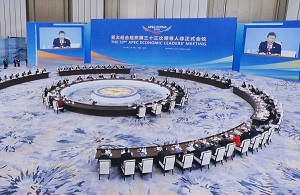
SHENZHEN, China — Chinese President Xi Jinping on Wednesday called for stronger Asia-Pacific cooperation based on solidarity, openness, innovation and inclusive development, announcing a $20 million contribution to support practical initiatives under the Asia-Pacific Economic Cooperation (APEC) framework.
Addressing the APEC Economic Leaders' Meeting in Shenzhen, Xi said the region was facing profound changes amid rapid advances in scientific and technological innovation and industrial transformation, requiring economies to adapt their cooperation to emerging opportunities and challenges.
He called for building an Asia-Pacific community characterised by solidarity and mutual assistance, openness and integration, innovation and inclusiveness, stressing that member economies should strengthen common interests and work together to overcome challenges.
Xi outlined four priorities for regional cooperation, starting with economic and trade integration. He called for advancing the Free Trade Area of the Asia-Pacific, aligning regional economic agreements, improving trade and investment facilitation and reducing barriers to cross-border economic activity.
He also stressed the importance of strengthening connectivity through infrastructure networks, smart customs and transport systems, closer policy and regulatory coordination and cooperation on cross-border payments.
Facilitating business and tourist travel, expanding cultural exchanges and promoting people-to-people contacts were also essential to strengthening mutual understanding and friendship across the region, he said.
On innovation, Xi called for stronger digital infrastructure, improved regional data governance and efficient and secure cross-border data flows.
He also urged APEC economies to promote an open innovation environment, encourage technological cooperation and support industrial transformation.
The fourth priority was inclusive and sustainable development, with Xi calling for deeper regional cooperation in energy and food security, natural resource management, environmental protection and green and low-carbon development.
He also highlighted the importance of improving people's livelihoods through investment in human development, employment and vocational training, women's economic empowerment, youth exchanges and initiatives addressing the needs of ageing populations.
China would also establish cooperation institutions covering digital technology, cross-border data flows, clean energy and the development of small and medium-sized enterprises, he said.
International Monetary Fund (IMF) Managing Director Kristalina Georgieva said artificial intelligence (AI) was becoming a major driver of global economic growth, productivity and medium-term competitiveness, helping offset the impact of energy supply disruptions linked to tensions in the Middle East.
Georgieva said AI had made a material contribution to global growth for the first time this year, with rapid AI-led expansion in around a dozen economies helping support global growth of 3.1 per cent.
APEC economies were performing better, recording growth of 3.4 per cent, while global trade expanded by 4.6 per cent, she said.
She attributed global growth to the AI investment boom and progress by countries in deepening regional trade integration, while noting significant differences among economies depending on their exposure to energy markets and integration into AI supply chains.
Georgieva cautioned that energy-importing economies and countries affected by El Niño and other shocks faced greater difficulties.
She warned that energy supply disruptions and increased demand linked to AI were pushing global inflation to 4.7 per cent this year, requiring tighter monetary policies in many economies.
Higher borrowing costs, combined with strong growth expectations and increased public and private borrowing, were also driving interest rates upwards, with bond yields in many advanced economies reaching their highest levels in decades.
She also warned that rising interest payments were putting pressure on government finances, as global debt was expected to approach 100 per cent of gross domestic product, its highest level since the Second World War.
Georgieva called for urgent action to address debt and fiscal deficits, alongside structural reforms to improve productivity and support growth.
She urged governments to invest in digital infrastructure, prepare workers and labour markets for AI adoption and establish safeguards against risks, particularly those affecting financial stability and cybersecurity.
Describing AI as the fastest transformation in human history, Georgieva warned that countries failing to adapt quickly risk falling behind.
She also stressed the importance of international cooperation through forums such as APEC, saying collective efforts were essential to achieving shared prosperity and peace.
Latest News
-
 Prime minister, Senate president discuss legislative priorities, economic projects
-
 King attends King Abdullah II Fund for Development’s 25th anniversary ceremony
-
 Al-Farrayeh Presents Jordan’s Refugee Policy at Vienna Migration Conference 2026
-
 Iran rules out UN inspections of damaged nuclear sites until war ends
-
 SSC sentences three men to death over Karak church attack