- Last Update24-Dec-2025


- Tweet
-
Safadi, Palestinian vice president discuss Gaza ceasefire, escalation in West Bank
The Jordan Times
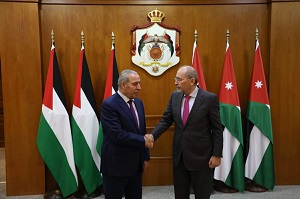
AMMAN — Deputy Prime Minister and Minister of Foreign Affairs Ayman Safadi on Tuesday met with Palestinian Vice President Hussein Al Sheikh to discuss efforts to consolidate the ceasefire in Gaza and stop Israeli escalation in the occupied West Bank.
During the meeting, the two officials stressed the priority of sustaining the ceasefire in Gaza, ensuring the full implementation of all its provisions, and moving towards the second phase of the agreement in line with US President Donald Trump’s plan.
They also emphasised the need to link efforts aimed at achieving stability with a clear political horizon that leads to a just and comprehensive peace based on the two-state solution, according to a ministry statement.
Both sides stressed that the future of the Gaza Strip must be based on its unity and connection with the West Bank, with the Palestinian National Authority assuming responsibility for the enclave in line with UN Security Council Resolution 2803.
They affirmed that Gaza is an integral part of the occupied Palestinian territory on which an independent, sovereign Palestinian state must be established, based on the two-state solution and in line with international legitimacy resolutions and the Arab Peace Initiative.
Safadi underlined the urgent need to step up efforts to deliver sufficient humanitarian aid to the Gaza Strip without delay, stressing that Israel must uphold its obligations under the ceasefire agreement and international law, and remove all obstacles preventing aid from reaching those in need.
The talks also highlighted “deep” concern over the deteriorating situation in the occupied West Bank, stressing the need for coordinated regional and international efforts to stop Israel’s unlawful measures, which escalate tensions and undermine prospects for a just and lasting peace based on the two-state solution.
The two sides emphasised the importance of Israel respecting the historical and legal status of Islamic and Christian holy sites in Jerusalem and removing all restrictions on freedom of worship, while also calling for an end to measures that limit Christians’ ability to practise their religious rites, particularly during religious holidays.
They also stressed the continuation of consultations and coordination, as well as efforts with regional and international partners, to achieve a just and comprehensive peace, involving an end to the occupation and the establishment of an independent, sovereign Palestinian state on the 4 June 1967 borders, with East Jerusalem as its capital, in line with the two-state solution, international legitimacy resolutions, and the Arab Peace Initiative.