- Last Update13-Oct-2026


- Tweet
-
Australia returns rare archaeological artefact to Jordan
The Jordan Times
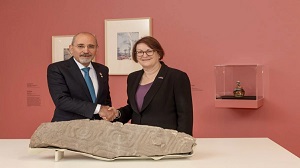
AMMAN — Australia has returned to Jordan a rare archaeological artefact dating to around 12,000 BC, discovered in northern Jordan during a joint Jordanian-Australian excavation, in a move highlighting cooperation between the two countries in preserving cultural heritage.
Deputy Prime Minister and Foreign Minister Ayman Safadi received the artefact on behalf of His Majesty King Abdullah during a handover ceremony at the National Gallery of Australia, held on the sidelines of the King’s state visit to Australia on Tuesday, according to a Foreign Ministry statement.
The artefact is one of three pieces that formed a carved architectural stone slab made of mudstone, discovered in 1983 at Wadi Al Hammah in Pella, also known as Tabaqat Fahl, by a joint archaeological mission from the University of Sydney and Wooster College. The pieces were transferred to the National Gallery of Australia in 1985 under agreed arrangements.
The artefact holds exceptional archaeological and historical significance, forming part of the world’s oldest known large-scale sculpture. The other two pieces are preserved in Jordan at the Jordan Museum in Amman and Dar Al Saraya Museum in Irbid.
The return reflects ongoing cooperation between Jordan and Australia in archaeological research, the preservation of cultural heritage and the repatriation of artefacts to their country of origin, the statement said.
During the handover ceremony, attended by Australian Special Envoy for the Arts Susan Templeman and museum officials, Safadi thanked the Australian government and the National Gallery of Australia for their cooperation in returning the artefact.
He also underscored the importance of continued cooperation between the two countries in archaeological excavation and the preservation of cultural heritage.
On the sidelines of the state visit, Safadi also met Australian Foreign Minister Penny Wong to discuss strengthening bilateral ties and expanding cooperation in areas including trade, investment, defence, security, tourism and education, according to the statement.
The two ministers also reviewed regional developments and efforts to end escalation and restore security and stability, while highlighting the visit’s role in advancing cooperation and coordination on regional and international issues of mutual interest.
Latest News
-
 North Korea fires 'several ballistic missiles' into Sea of Japan
-
 France urges Palestinians not to delay elections
-
 Central Bank gold reserves hit record $10.7 billion — official data
-
 Deadly Houthi attack on Riyadh airport 'not acceptable,' Trump says
-
 King condoles Saudi monarch, crown prince over attacks on Abha, King Khalid international airports