- Last Update29-Nov-2026


- Tweet
-
Prime minister unveils plans for JD120 million development project in Mafraq
The Jordan Times
AMMAN — Prime Minister Jafar Hassan has announced plans for an integrated development project in the eastern city of Mafraq worth more than JD120 million, as the government moves ahead with feasibility studies and efforts to secure funding for its various components.
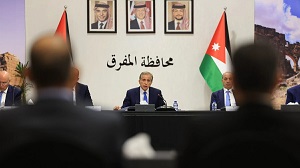
Speaking during a Cabinet meeting held in Mafraq, Hassan said that the proposed project would capitalise on the governorate's strategic location, which includes a promising development zone, an adjacent military airport and the Jaber Border Crossing, located approximately 17 kilometres away.
The project was presented at the Jordan-EU Investment Conference, held recently at the Dead Sea. The airport component alone is estimated to cost around JD35 million, Hassan said in a Prime Ministry statement.
He added that developing the Jaber border crossing with Syria through a public-private partnership is expected to cost approximately JD96 million. “The government is currently working to attract and qualify investors, with the project included in its pipeline of planned investments for 2027–2029.”
The Mafraq Development Zone will also be connected to the national railway network, which the government launched several months ago. The planned route will link Aqaba with Maan, extend to Al Madouna and continue to the Mafraq Development Zone and the Jaber border crossing, providing a connection to Syria and the wider region.
Hassan stressed that the government views the development zone as part of a broader, integrated economic vision that requires close cooperation with the private sector.
Investment and Industrial Development
Hassan said that investment activity at the King Hussein Bin Talal Development Zone had improved following government incentives and facilities, with occupancy rates rising from approximately 24 per cent to 40 per cent.
The Premier said that the government is continuing its efforts to attract additional industrial investment to the zone, alongside infrastructure projects aimed at reducing operating costs and strengthening industrial competitiveness.
“A natural gas supply project, valued at approximately JD18 million, is currently under way to serve the development zone. The initiative forms part of a nationwide strategy to extend natural gas infrastructure to industrial areas, with the aim of reducing energy costs by between 35 and 60 per cent, enhancing the competitiveness of local industries and supporting national exports.”
Separately, the government plans to establish a 10-megawatt solar energy project for the Mafraq Industrial Zone at an estimated cost of JD7 million, with implementation scheduled to begin next year.
Hassan said that the government had identified 140 service, productive and development projects across Mafraq Governorate, with a combined value approaching JD500 million and an overall completion rate of approximately 84 per cent.
“Of these, 60 projects have been completed at a cost of around JD95 million, while 49 are currently under way. The remaining 31 are included in the government's future project plans.”
He reaffirmed the government's commitment to completing all projects agreed upon with local representatives, adding that planning and implementation were being carried out in partnership with the governorate's representatives.
The prime minister also reviewed projects completed over the past year with Mafraq's parliamentary representatives, as part of the development plan agreed upon during a Cabinet meeting in the governorate a year earlier.
The government has issued a tender for the construction of an additional building at Mafraq Government Hospital, with an estimated cost exceeding JD10 million. The project is scheduled for completion in 2028, the statement said.
The new facility will include a 55-bed emergency department, a dialysis unit equipped with 30 machines, 10 intensive care beds and an additional floor for outpatient clinics.
Meanwhile, work on the development of North Badia Government Hospital has reached 85 per cent completion, Hassan said.
In the education sector, Hassan said that the government has built and opened nine new model schools across the governorate and expanded classroom capacity at 13 other schools over the past two years, at a combined cost of approximately JD17 million.
“Construction is currently under way on four additional model schools, at an estimated cost of JD12 million.”
Over the next two years, the government plans to build another six schools at a cost of JD20 million. It will also establish Rehab Vocational School, a project valued at more than JD5 million, to expand access to technical and vocational education, he said.
Hassan said that the initiatives aim to equip young people with the skills needed to benefit from employment opportunities generated by existing and future investments in the governorate.
The government will also co-ordinate with the Ministry of Labour to upgrade vocational training centres, particularly in remote areas. Discussions are also under way with Al al-Bayt University regarding the possible establishment of an agricultural college in Mafraq.
Water and Infrastructure Projects
The government is allocating more than JD100 million to address water supply shortages in several areas of Mafraq and the Badia region through the development and rehabilitation of water networks and related infrastructure, Hassan said.
He added that the government was working with the Ministry of Public Works and Housing to gradually improve Baghdad Road as part of a medium-term plan.
Plans are also under way to expand the newly inaugurated Mafraq Public Park, located on land belonging to Al al-Bayt University, in phases according to local needs.
In co-operation with the university, the government will also work to rehabilitate the sports city and make its facilities accessible to residents and young people across the governorate.
Hassan emphasised the importance of strategic planning and responding to the needs of communities in villages, rural areas and Bedouin settlements, while maintaining co-ordination with MPs, municipalities and local associations.
Latest News
-
 Jordan, EU lead UfM call for regional stability, stronger Mediterranean cooperation
-
 Crown Prince meets with Ireland president
-
 Europeans should visit Moscow before joining Ukraine talks - Russian envoy to AFP
-
 Saudi-led coalition says Houthi projectile hits kingdom's Jazan port
-
 Crown Prince attends Jordan-Ireland ICT Forum TechConnect