- Last Update27-Nov-2026


- Tweet
-
Jordan, EU lead UfM call for regional stability, stronger Mediterranean cooperation
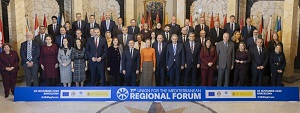
The Jordan Times
AMMAN — Foreign ministers of the Union for the Mediterranean (UfM) have called for renewed regional cooperation and stronger diplomatic efforts to address mounting security challenges, reaffirming their commitment to peace, stability and prosperity across the Mediterranean.
In a joint statement issued following the 11th UfM Regional Forum in Barcelona on Tuesday, ministers, meeting under the co-presidency of Jordan and the European Union, called for a more action-oriented and forward-looking organisation capable of responding to the region's growing challenges.
In their joint statement, ministers reaffirmed the UfM's role as a platform bringing together Mediterranean partners and pledged to advance the implementation of its 2025 Vision Statement, focusing on three pillars aimed at connecting people, countries and economies.
They identified environmental protection, climate action, energy transition, digital transformation, higher education and connectivity as priority areas requiring stronger regional cooperation. They also highlighted opportunities to expand trade and partnerships, calling for joint efforts to transform shared challenges into mutually beneficial opportunities.
The statement, a copy of which was made available for The Jordan Times, expressed concern over the security situation in the Middle East and Gulf Cooperation Council (GCC) countries, stressing the importance of respecting international law and intensifying diplomatic coordination with regional and international partners to prevent further escalation and restore stability.
On the Palestinian issue, the ministers reiterated their commitment to achieving a comprehensive, just and lasting peace based on the two-state solution, under which Israel and Palestine would coexist as democratic states within secure and internationally recognised borders, in accordance with relevant United Nations Security Council resolutions.
They voiced concern over the lack of progress in implementing the ceasefire and other provisions of UN Security Council Resolution 2803, while calling for support for the Global Alliance for the Implementation of the Two-State Solution.
The ministers also expressed grave concern over the deteriorating situation in the occupied West Bank, rejecting unilateral measures, annexation, settler violence, settlement expansion and any forced displacement or expulsion of Palestinians from Gaza or the West Bank.
They called for an immediate halt to measures undermining the two-state solution and stressed the need to preserve the legal and historical status quo of Jerusalem's holy sites, including the Hashemite custodianship.
The statement also underscored the indispensable role of the United Nations and its agencies, particularly the UN Relief and Works Agency for Palestine Refugees (UNRWA), in providing essential assistance to civilians in Gaza and across the region.
The ministers called for the unhindered delivery of humanitarian aid to Gaza and the West Bank, stressing that humanitarian organisations must be allowed to operate independently and impartially. They also emphasised that civilians must be protected at all times and that all parties must comply with international humanitarian law.
On Lebanon, the ministers welcomed the framework agreement signed by Lebanon and Israel in June 2026, urging all parties to honour its provisions and engage constructively in further negotiations aimed at achieving a permanent end to hostilities.
They also called for the full implementation of UN Security Council Resolution 1701, describing it as the basis for any lasting solution.
Regarding Syria, the ministers reaffirmed their support for the country and its government's efforts to rebuild the state while safeguarding its security, stability, unity and sovereignty.
They stressed the importance of continuing support for Syrian refugees and host countries until conditions allow for voluntary, safe and sustainable refugee returns.
On Ukraine, the ministers called for realising a comprehensive, just and lasting peace in accordance with the UN Charter. They reaffirmed their support for Ukraine's sovereignty, independence, unity and territorial integrity within its internationally recognised borders, including its territorial waters.
They also welcomed ongoing US-led efforts to facilitate peace through direct negotiations and stressed the importance of achieving a full, comprehensive and reciprocal ceasefire.
Gulf security and freedom of navigation
The statement also expressed support for GCC countries, warning that continued instability in the Gulf could disrupt global supply chains, particularly those involving energy, fertilisers and food.
Such disruptions, the ministers cautioned, could have serious consequences for economies and vulnerable populations across the Mediterranean region and beyond.
They stressed the importance of safeguarding freedom of navigation and maritime security in accordance with international law, specifically highlighting the right of passage through the Strait of Hormuz.
In this context, the EU-Jordanian co-presidency referred to the No Fees/No Tolls Pledge and invited all UfM member countries to join the initiative.
The ministers reaffirmed their commitment to strengthening the UfM as a platform for practical cooperation, with renewed efforts to address regional crises, deepen economic partnerships and advance a shared vision of peace and prosperity throughout the Mediterranean.
Latest News
-
 Jordan, Uzbekistan issue joint statement following conclusion of talks between King, Uzbekistan president
-
 King, Uzbekistan president witness exchange of agreements, MoUs
-
 King, Queen receive Uzbekistan president, first lady at start of their state visit to Jordan
-
 Crown Prince meets with Enterprise Ireland executive directors
-
 Prime minister reviews gov’t’s two-year achievements, outlines priorities for next phase