- Last Update20-Sep-2026


- Tweet
-
Turning Syrians Against the Revolution - By
Maher Abu Tair, Jordan News
The popular protests witnessed in Syria, which extended to several provinces in objection to the rise in fuel prices, were not merely livelihood related protests, but speak to something more.
After 14 years of suffering due to the war within Syria, and the killing, displacement, destruction of property, and security repression the Syrian people endured, the Syrian people cannot remain as they were, because celebrating the fall of the previous regime alone does not grant the current regime license to disregard Syrians' demands. Rather, it places an additional responsibility on it, amid heightened sensitivity among Syrians toward every detail of their lives, after they moved from the atmosphere of celebrating change into the obligations and responsibilities of social and economic life.
Syria is under enormous pressure. Israel is expanding in the south, economic aid to Syria is limited, and wealthy Syrian money held by expatriates and immigrants is not approaching the new Syria, perhaps out of fear that conditions could suddenly collapse. Several groups within Syria are restless and mobilizing along sectarian, ethnic, and religious lines, ranging from those who want secession, to those who hold objections, to those with external ties that moved them before and may now be moving them under the cover of livelihood protests rather than political objections.
Turning Syrians against the Syrian revolution that has become a state is happening due to objective circumstances, and may increase due to external interference, but the current reality certainly cannot be oversimplified in any case.
The Syrian people's aspirations after the revolution were great, chief among them the nature of the relationship between the state and society, and this is the root of the crisis, because the previous Syrian crisis was founded on security repression, sectarian power sharing, and contempt for the Syrian individual, their political freedom, and their livelihood. There is much detail here regarding the previous regime, which is why Syrians' sensitivity is doubled today.
The most prominent reasons for Syrians' sensitivities are the way the state deals with citizens, the formation of pockets of influence tied to the new Damascus internally, the emergence of specific capital based polarizations, and a shift in the revolution's slogans from freedom and granting Syrians their rights, toward international repositioning, including the relationship with Israel, along with the failure to accomplish anything on the reconstruction front, for example, Syrian refugees remaining outside Syria, widespread unemployment and poverty, and the exorbitant cost of living that Syrians can no longer bear.
This means that the objective reasons Syrians understood during the previous regime's era as having led to the conditions they lived under will not be understood the same way today. What is striking is that Syrian voices have emerged expressing nostalgic sorrow for the previous era, whether emotionally or even driven by certain parties, a situation we saw, for example, in Libya after its revolution, when people emerged after a period to mourn Gaddafi. It is a great paradox that Arab people these days find themselves only able to compare between the worse and the bad.
But wait, we must be objective, because the new Damascus will not be able, at the speed Syrians expect, to change conditions, given the scale of destruction and economic devastation, the complexities of the domestic scene, and regional pressures. It may therefore be an exaggeration to expect Syrians to see an overhaul overnight, an impossibility in every sense of the word, and what was destroyed over 14 years will not improve in a year or two. Perhaps the most important thing today is halting the deterioration and destruction, before development.
The most important element here is that livelihood protests may find internal and external forces fueling them for political rather than livelihood reasons. There are states and security agencies operating in Syria, financed forces, angry minorities, and also forces aligned with the previous regime that want to bring down the current one, forces that are military, security, partisan, and tribal. Alongside all this, there are international powers wanting to expand into Syria once again, such as Iran and Russia, and beyond all of them, Israeli plans to undermine Syria from within, within a context of a desire to divide it or subject it to Israeli tutelage.
What happened in the way of livelihood protests was the first chapter, and the greater danger lies in the plan expanding between people's legitimate protests and those who would exploit them for other purposes, meaning that the new Damascus faces a decisive moment and needs to quickly reorganize its internal affairs, and Syria also needs to be supported.
Latest News
-
 King meets with Czech defence industry company executives
-
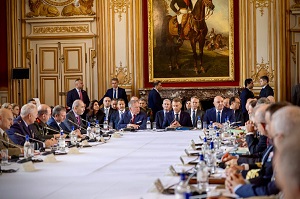 King, France president, Lebanon president chair new round of Aqaba Process meetings in Paris
-
 Jordan, France issue joint statement following conclusion of talks between King, France president
-
 King, France president discuss ties, witness signing of defence cooperation agreement in Paris
-
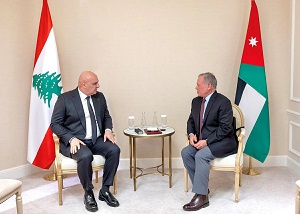 King meets with Lebanon president, underscores Jordan’s support for Lebanon