- Last Update30-Oct-2026


- Tweet
-
Jordan must act alone against terrorism when others fail to act - By Raed Omari, The Jordan Times
No country has supported Syria as Jordan has, and no people have welcomed Syrians as warmly as the Jordanians have. Period.
Having stated this frankly, proudly and unequivocally, I can confidently point to further established facts about Jordanian-Syrian relations.
Relations between Amman and Damascus appeared to be on a sound footing following the fall of Bashar Al Assad’s regime in December 2024. However, tensions appeared to surface after Jordan carried out airstrike against terrorist targets in southern Syria on Monday.
Behind those strikes lies a deeper story: Jordan’s growing frustration with Syria’s failure to curb the presence of radical groups operating in the country’s south, close to Jordan’s northern border.
According to information available to me, Amman has repeatedly urged Damascus to take decisive action against extremist organisations operating along the two countries’ approximately 400-kilometre border. These groups, according to senior Jordanian security sources, have been involved in drug-smuggling operations targeting Jordan.
More troublingly, I have also learned that some of these groups have cooperated with Israel in activities aimed at destabilising Jordan.
History offers a reminder of how seemingly incompatible forces can find common ground when their interests converge. In 2014, the Daesh extremist group and elements of former Baathist network cooperated in Iraq despite their ideological differences.
The question, then, is why Syria’s new rulers have not done more to confront extremist organisations in the country’s war-ravaged south.
According to Jordanian sources, the Syrian authorities are grappling with an array of problems and challenges as they attempt to rebuild state institutions and restore stability. These competing demands may have limited their capacity to address the threat effectively.
Syrian sources, however, offer another explanation. They suggest that the government’s inaction may also reflect internal ideological divisions, arguing that some officials within the new administration continue to hold extremist views that complicate the authorities’ efforts to establish a coherent governing approach.
There is much more to be said about these competing explanations. But the central issue remains clear: Jordan cannot afford to leave its national security dependent on another country’s ability or willingness to act.
Jordan has confronted Daesh-related threats in Syria before, and it may once again find itself compelled to act when it believes that the danger cannot be contained through cooperation alone.
As such, the recent airstrikes were not intended to destabilise Syria or violate its sovereignty, as some critics have argued. Rather, they should be understood, in Jordan’s view, as a security measure directed at a common threat: terrorism.
For more than 15 years, Jordan has faced repeated terrorist threats and attacks, including the Irbid cell, the Karak attack, the Rukban bombing and the Salt incident. More recently, the attack on Hmoud Church last Friday has added to those concerns. The official Jordan has repeatedly linked various security threats to Daesh and its networks in Syria.
These experiences have reinforced a fundamental lesson for Jordan: threats originating beyond its borders can have direct and devastating consequences at home.
Cooperation with Damascus remains essential. A stable Syria is in Jordan’s interest, and effective coordination between the two countries would serve both peoples. But cooperation cannot become an excuse for inaction when an immediate threat to Jordan’s security persists.
Ultimately, every state has a duty to protect its citizens. When neighbouring authorities are unable or unwilling to address threats emanating from their territory, Jordan may conclude that it has no choice but to act on its own.
Jordan has shown extraordinary solidarity with the Syrian people. It is now asking Damascus to demonstrate that solidarity in return by taking meaningful action against the groups threatening their shared security.
Latest News
-
 King inaugurates SOFEX 2026 in Aqaba
-
 Heavy rain expected nationwide as JMD issues flood warning
-
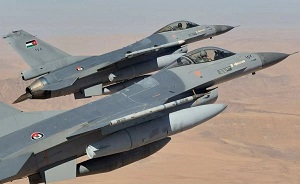 Jordanian Air Force strikes terrorist targets in southern Syria — JAF
-
 King meets with Iraq PM, underlines deep Amman-Baghdad relations
-
 Karak attack terrorists acted alone, motivated by extremist ideology – police chief