- Last Update27-Mar-2026


- Tweet
-
Heritage under Fire : Lebanon’s archaeological sites under threat
AFP
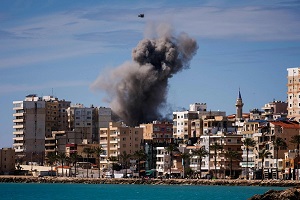
AMMAN – As Israeli strikes continue to hit areas across Lebanon, concern is growing not only for civilian lives but also for the country’s archaeological heritage.
Even when major sites such as Tyre and Baalbek are not directly targeted, experts warn that proximity alone can cause serious and lasting damage.
Lebanese archaeologist Nelly Aboud, founder of Museolab, explains that the absence of visible destruction does not mean a site has been spared.
“First, we do not know anything about the type of explosives Israel is using or what type of missiles,” she told The Jordan Times. “We also have reports of the use of phosphorus bombs banned internationally.”
This uncertainty complicates immediate assessments, but the risks are well understood. According to Aboud, indirect damage from nearby explosions can be severe.
“Explosions nearby can send strong ground vibrations that could crack ancient masonry and destabilise columns,” she explains, pointing to sites such as Baalbek. “Even without visible direct collapse, micro-fractures accumulate and can lead to total collapse.”
These fractures, often invisible at first, weaken structures over time. Repeated blasts increase structural fatigue, causing stones to shift and arches to lose stability.
Even Baalbek’s massive stone blocks—among the largest ever used in construction—are not immune. While their size offers resistance against immediate collapse, they remain vulnerable to gradual displacement caused by vibrations.
Beyond structural stress, debris and shrapnel present additional threats. Decorative elements, inscriptions, and carved reliefs can be chipped or erased, while mosaics may be damaged and archaeological layers exposed.
“These types of damages can be measured and proven afterwards,” Aboud noted, citing the work of researchers such as stone deterioration specialist Lisa Mol, whose ‘Heritage in the Crossfire’ project has developed methods to quantify blast-related damage using non-invasive techniques and remote data.
However, the risks extend beyond physical damage. The lack of conservation teams on the ground further accelerates deterioration.
“The lack of human resources on the ground to maintain and continue the conservation poses additional concerns,” she said.
Instability also increases the likelihood of looting and illegal excavations, as weakened oversight creates opportunities for theft and vandalism.
Despite their status as UNESCO World Heritage sites, Tyre and Baalbek remain highly vulnerable. International frameworks such as the 1954 Hague Convention for the Protection of Cultural Property in the Event of Armed Conflict are intended to safeguard such sites, but their effectiveness is limited in practice.
“Protection means something, but in practice, it is often very limited,” Aboud said. “International conventions rely on compliance. At the time of conflict, does all this protect the site? No, it doesn’t.”
Instead, these frameworks function primarily as tools for documentation and accountability.
“What protection can do is create documentation and accountability,” she explained. “It can enable future legal claims, help mobilise international pressure, and justify post-conflict funding for restoration. But it does not provide on-the-ground protection.”
Recent events in Tyre illustrate how close these risks have come. An Israeli strike just meters from the Al-Bass archaeological site caused material damage within the complex.
Lebanese Minister of Culture Ghassan Salamé condemned the incident, denouncing what he described as the targeting of the country’s cultural heritage.
“The site is inscribed on the UNESCO World Heritage List and is also included on the enhanced protection list under the 1954 Hague Convention,” Salamé stated.
He emphasised that archaeological sites contain no military or security presence, rejecting any justification for their targeting.
“After contacting the security services and the governorates, it has been established that the archaeological sites do not include any military or security presence,” he said. “Therefore, this argument cannot be used to justify their bombardment or any infringement on their integrity.”
Salamé added that these sites fall directly under the administration of the Directorate General of Antiquities and confirmed that Lebanon had formally requested international intervention to help safeguard its heritage during the ongoing hostilities.
The situation in Lebanon reflects patterns observed elsewhere in the region. In Syria, sites such as Palmyra have suffered both direct destruction and widespread looting.
“These are not isolated cases,” Aboud said. “Archaeological sites are often targeted or affected as part of broader strategies that impact cultural identity and sovereignty.”
As the situation continues, Lebanon’s archaeological heritage remains exposed—not only to direct Israeli strikes but also to the cumulative effects of nearby violence. Much of this damage may remain invisible until it is too late.
Latest News
-
 UN chief says Lebanon must not become next Gaza amid fighting
-
 Iran launches 5 missiles, drone towards Jordan, all but one intercepted — JAF
-
 Trump says Iran gave US 'very big present' related to oil and gas
-
 UN rights council to hold urgent debate on Iran's attacks on Gulf states
-
 Israel says will take 'control' of security zone in south Lebanon