- Last Update27-Feb-2026


- Tweet
-
The Hashemite roadmap: From diplomatic initiative to sustainable development - By Hasan Dajah, The Jordan Times
In the realm of contemporary international politics, the diplomatic initiatives of His Majesty King Abdullah, coupled with the dynamic and youthful vision of His Royal Highness Crown Prince Hussein, stand out as a solid model of strategic diplomacy aimed at safeguarding Jordan's supreme national interests and consolidating stability in a region rife with turmoil. Anyone observing the recent intensive royal activity will realize that Jordan is playing a proactive and leading role, seeking to redefine regional balances, based on historical legitimacy and broad international acceptance. This was clearly demonstrated in the series of meetings and summits hosted by Amman with leaders from various continents and political orientations, from Indonesia in the east to Germany and Albania in the west. The Crown Prince's accompaniment of His Majesty the King on these tours not only reflects the continuity of the Hashemite approach but also infuses Jordan's "soft power" with digital and youthful dynamism. This enhances the Kingdom's ability to engage with global powers in contemporary terms and transforms Amman into a hub for decision-makers seeking to build cross-border partnerships that ensure sustainable security and peace in a volatile region.
Based on a deep-rooted Hashemite historical legacy and a high level of international trust, Jordan has successfully positioned Amman as a destination for decision-makers from across the globe. From the rising economic power of Indonesia in the east to the industrial and political weight of Germany and Albania in the west, Jordan is weaving the threads of strategic cross-border partnerships. These partnerships aim to build robust regional balances that safeguard national sovereignty, open up broad horizons for quality investment, and establish a unique model of "positive engagement" with the international community.
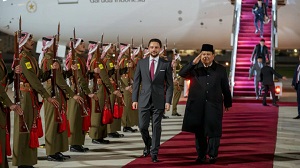
This ensures the sustainability of security and peace in a volatile region, while consistently emphasizing that Jordan's stability is the cornerstone of the stability of the entire region. The high-level talks with Indonesian President Prabowo Subianto at Basman Palace marked a strategic turning point in Jordan's diversification of international partnerships. The move towards a rising economic power like Indonesia reflects an awareness of the need to build transcontinental alliances that transcend traditional models. The two leaders focused on elevating the relationship, which spans more than 75 years, and developing it in promising sectors such as business, investment, energy, science and technology, health, and defense cooperation. This shared economic and security vision was not divorced from regional concerns, as the Indonesian President warned of the dangers of escalation in the West Bank and its impact on efforts to restore stability in Gaza. He affirmed his country's support for implementing the ceasefire agreement and establishing an independent Palestinian state, based on the outcomes of His Majesty King Abdullah II's visit to Indonesia last November.
This eastward orientation is complemented by the deepening of ties with Europe, exemplified by the visit of German President Frank-Walter Steinmeier and the First Lady to the Kingdom. Germany represents a key strategic partner for Jordan in the fields of development and diplomacy. His Majesty King Abdullah's talks with Albanian President Bajram Begaj at Al Husseiniya Palace further solidified Jordan's position as a hub for security and political coordination. His Majesty commended the outcomes of the Aqaba Meetings, held in partnership with Albania, emphasizing that these gatherings represent an opportunity to further strengthen friendship and international cooperation in the face of shared challenges.
From an analytical perspective, these European and Asian visits were not merely protocol-driven political meetings, but rather strategic initiatives aimed at bolstering Jordan's economic security and attracting foreign direct investment. The focus on Indonesia opens doors for Asian capital to invest in vital sectors such as phosphates, fertilizers, and renewable energy, leveraging Jordan's strategic location as a logistics hub and its free trade agreements with the West. Conversely, strengthening ties with Germany and Albania reinforces European investor confidence in the Jordanian business environment, positioning the Kingdom as an island of stability and a secure Launchpad for major projects in technology, digital transformation, and green hydrogen. This diversification reduces reliance on traditional sources of funding and gives the national economy greater flexibility in the face of global fluctuations, transforming political agreements into joint projects that create jobs and support the "vision of economic modernization".
At the heart of this flurry of diplomatic activity, the Palestinian cause remains the unwavering principle guiding the King's actions. His Majesty is leading an international moral and legal front to confront Israel's systematic expansionism, which aims to undermine the two-state solution by consolidating its control over the West Bank. His Majesty's repeated warnings against the ongoing violations of Islamic and Christian holy sites in Jerusalem, which are under Hashemite custodianship, place the international community before its historical responsibilities, clarifying that disregarding Palestinian rights is a blatant violation of international law and the UN Charter. This role extends to a comprehensive vision for the security of neighboring countries, where His Majesty emphasizes the need to support the efforts of Syria and Lebanon to maintain their security and sovereignty, while stressing the importance of dialogue and diplomacy in reducing tensions related to Iran.
The King's intensive engagement with the leaders of Indonesia, Germany, and Albania, with the active participation of His Royal Highness the Crown Prince, is part of a comprehensive strategy aimed at protecting Jordanian sovereignty and safeguarding the interests of the Jordanian people. By diversifying partnerships and adhering to international law, Jordan proves that despite the challenges of the region, it possesses a political and moral weight that makes it a pivotal player that cannot be ignored, stressing that the true strength of countries lies in the clarity of their vision and the ability of their leadership to shape the future in the language of peace and humanitarian cooperation.
Hassan Al-Da'jah — Professor of Strategic Studies at Al-Hussein Bin Talal University