- Last Update27-Sep-2026


- Tweet
-
Water and sovereignty: Why Jordan’s security begins in southern Syria - By Hasan Dajah, The Jordan Times
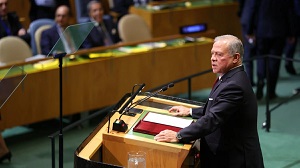
Safeguarding Jordan’s national security is no longer measured solely by the state’s ability to control its borders and prevent incursions; the water reaching households, the food produced from the land, and the stability of agricultural communities are all fundamental components of the sovereignty equation. From this perspective, southern Syria holds significance that transcends mere geographic proximity, as shifts there could impact Jordanian resources and interests. His Majesty King Abdullah clearly articulated this reality in his address to the UN General Assembly, warning against Israel’s continued approach in southern Syria and emphasizing that any threat to our northern borders or water security constitutes a threat to our national security.
This royal warning establishes a strategic vision that links border protection with the preservation of resources and the continuity of life and production, while holding the international community accountable regarding the risks of escalation. Consequently, the question today is: How can Jordan translate this sovereign stance into preventive policies, national projects, and regional partnerships that protect its water security, reinforce its independent decision-making, and prevent the basic needs of its citizens from becoming advantage points dictated by instability or regional power dynamics?
The importance of this question is heightened by concerns regarding Israeli maneuvers in southern Syria and their repercussions for Jordan’s security, borders, and water interests. Recent media coverage has underscored the link between these developments and Jordan’s national security calculations. However, a responsible strategic assessment requires distinguishing between potential risks and established facts; not every military maneuver should be viewed as evidence of altered water flows, yet the possibility of impacts on shared resources necessitates early monitoring and both political and technical preparedness.
The problem lies in the intersection of domestic resource vulnerability and external uncertainty. Jordan faces chronic water scarcity and pressures stemming from population growth and climate change, alongside challenges regarding network infrastructure and groundwater sustainability. Upon launching its 2023–2040 strategy, the Ministry of Water and Irrigation noted that per capita water availability had dropped to less than 61 cubic meters annually. This indicator reveals the limited room for maneuver available to the state when resources dwindle or supplies are disrupted, underscoring that crisis prevention is far less costly than managing the aftermath.
This equation is particularly sensitive in the Yarmouk Basin, where the interests of both nations are intertwined with shared water resources and their management. Any disruption to facility operations, information exchange, or technical coordination could significantly complicate planning efforts. Furthermore, should control over resources be leveraged as a tool for political influence, it would compound natural scarcity with strategic pressure. Consequently, Syria’s stability, territorial integrity, and institutional capacity to manage its resources serve Jordan’s direct interests, providing a more sustainable foundation for cooperation and the protection of mutual rights.
The consequences of water scarcity extend well beyond distribution schedules; Household expenditures on water could rise, farmers' productive capacity could decline, and rural employment opportunities could suffer. Some of these pressures may translate into higher food prices, depending on the specific crops and the availability of alternatives. Low-income households bear the heaviest burden, as they have limited means to finance storage or purchase additional supplies. Consequently, equitable water supply becomes a component of social stability, and water security evolves into a livelihood issue that citizens experience on a daily basis.
A practical response begins with strengthening Jordanian-Syrian coordination through a permanent mechanism that brings together experts in water management, diplomacy, and border affairs, operating within existing bilateral frameworks. Key priorities include the regular exchange of data on water flows and storage levels, the installation of mutually agreed-upon measuring instruments, and the establishment of an early-warning protocol for malfunctions, contamination, and unusual fluctuations. This mechanism should produce joint drought and emergency plans, ensuring that demands and positions are grounded in verified data and that technical disputes are resolved before they escalate into broader political issues.
In parallel, the Kingdom requires a proactive diplomatic approach that explicitly integrates the protection of water resources and infrastructure into its Arab and international engagements. The diplomatic efforts led by His Majesty can be leveraged to mobilize support for stability in southern Syria, as well as funding for resource monitoring and the rehabilitation of water infrastructure. Such initiatives are most effective when Jordan presents specific dossiers outlining the risks and necessary measures, linking water security to regional stability while upholding Syria’s sovereignty and safeguarding Jordanian interests.
Domestically, the National Water Carrier project stands at the forefront of efforts to bolster water capacity, targeting an annual output of 300 million cubic meters through seawater desalination. Its significance necessitates close monitoring of implementation via publicly announced indicators, strict cost control, and the secure provision of energy, operations, and maintenance. Furthermore, the project’s facilities and pipelines must be safeguarded, and contingency plans established to ensure service continuity during breakdowns; increased production yields its full impact only when accompanied by reliable transmission, distribution, and emergency response capabilities.
In parallel, the national interest dictates the construction of a resilient water system-one capable of withstanding shocks-based on diversified sources, expanded strategic storage, and interconnected governorate networks that allow for supply exchanges during emergencies. Reducing water loss should be treated as an investment in an additional resource, utilizing contracts linked to actual volumes of recovered water. System protection also requires securing alternative energy sources for critical facilities, enhancing physical and cybersecurity measures, and preparing plans to maintain supply continuity should a primary source fail.
This approach is rounded out by a strategy that elevates the reduction of Jordan’s vulnerability to water stress to a national security objective. This entails increasing resources under national control and avoiding critical reliance on a single external source. At the regional level, this vision calls for a strategic partnership with Syria to protect the Yarmouk Basin, the inclusion of safeguards for Jordanian water interests in any arrangements concerning southern Syria, and the pursuit of international guarantees and monitoring mechanisms to prevent the imposition of conditions that would harm these interests.
Furthermore, the Kingdom should leverage its partnerships-both domestic and international-to finance its water independence and link regional stability to the protection of shared resources. The ultimate goal is to secure alternatives that empower Jordan to resist external pressures without jeopardizing its citizens' needs; for as the ability of external actors to influence its vital resources diminishes, Jordan’s political maneuverability expands, thereby strengthening its capacity to safeguard its sovereignty and transform the royal warning into a sustainable, proactive policy.
Latest News
-
 King’s UN address puts Israel, international community on notice over Gaza, West Bank
-
 Golan will remain Syrian, vows President Al Sharaa at UN
-
 Foreign minister calls for ‘concrete, deterrent’ measures to uphold two-state solution
-
 King participates in multilateral meeting at invitation of President Trump
-
 US to build two military bases in southern and eastern Greenland