- Last Update21-Jan-2026


- Tweet
-
The race to salvage Gaza’s vanished heritage
AFP
AMMAN — As dust settles over the ruins of Gaza, a quieter effort is unfolding among the wreckage: attempts to preserve what remains of a 5,000-year-old history.
While the human toll of the conflict has been severe, with casualty figures reported by the Euro-Mediterranean Human Rights Monitor to be in the tens of thousands, international agencies are now warning of a secondary, long-term loss — what they describe as the potential “cultural erasure” of the Palestinian enclave.
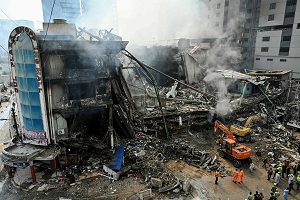
The scale of damage to Gaza’s tangible history has been extensive. In a recent assessment, UNESCO documented damage to 110 specific sites of cultural significance, including religious landmarks and buildings of historical or artistic importance. However, local documentation suggests an even broader impact. The Euro-Mediterranean Human Rights Monitor reports that the destruction forms part of what it describes as a systematic campaign targeting the “urban fabric” of Gaza’s Old City, threatening material symbols of Palestinian identity.
Among the losses is the Great Omari Mosque. Once a Byzantine church before its conversion in the 7th century, the mosque served as a central religious and architectural site in Gaza City. Reuters reports that while Israeli forces claimed the site sat atop a tunnel network — a claim Palestinians deny — the resulting strikes destroyed large parts of the complex. Similarly, the Pasha’s Palace, a 13th-century fortress that once housed a museum of ancient artefacts, has seen more than 70% of its structure damaged, according to the Palestinian Ministry of Tourism and Antiquities.
Despite the scale of the task, recovery efforts have begun in what the Palestinian Ministry of Tourism and Antiquities describes as a “first phase” — an intervention aimed at stabilising structures at risk of immediate collapse. Expert teams are currently engaged in the manual sorting of stones, separating ancient sandstone masonry from common debris in hopes of future restoration.
The work, however, is constrained by a lack of resources. As noted by AFP, restoration specialists are operating under constant surveillance, often using bare hands to clear rubble because specialised materials such as white cement and gypsum are scarce in the local market. The Palestinian Ministry of Tourism has estimated that an initial recovery plan for historical sites alone will require at least $133 million, a figure that continues to rise as prices for excavation materials increase.
Beyond physical damage, the loss of what experts term “intangible heritage” is drawing concern from international observers. The Euro-Mediterranean Monitor argues that these actions constitute a violation of the 1954 Hague Convention for the Protection of Cultural Property. The agency emphasises that these landmarks do not belong solely to the Palestinian people but form part of world heritage, representing a mix of Canaanite, Roman, Byzantine, and Islamic civilisations.
Reuters highlights the impact felt by residents, noting that for a population largely composed of refugees, these ancient sites served as a primary link to ancestral heritage. The destruction of the Al Qaisariyya gold market and other historic neighbourhoods is viewed by many residents as an attempt to erase Palestinian identity, according to the news agency.
As the international community looks toward a potential recovery, the cultural sector remains a point of concern. The United Nations and UNESCO have been called upon to place threatened sites under emergency international protection, yet the reality on the ground remains a race against time and ongoing deterioration.
For now, the effort remains largely grassroots. Local architects and volunteers continue to excavate artefacts from the ruins, recently recovering items from the Roman and Islamic eras. At the damaged edge of the Great Omari Mosque, stones are being stacked by hand into small, labelled piles — placeholders for a future that remains uncertain.