- Last Update23-Nov-2026


- Tweet
-
Shenzhen Is Not Yalta: A Summit to Test Conflict Management, Not to Divide the World - By Ahmad Abdulbaset Rjoub, The Jordan Times
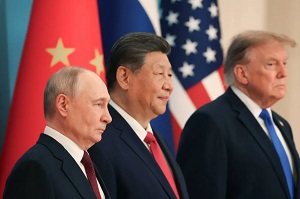
Not every historical photograph is a historical event, and not every summit of the world’s most powerful leaders can redraw the global map. The comparison between the Shenzhen summit and the 1945 Yalta Conference may tempt the press, but it does not withstand scrutiny. The image is symbolic: an American president beside a Russian president and a Chinese president at a moment of international turmoil, raging wars, and growing talk of a multipolar world. But Yalta was different: a world emerging from global war, victorious armies drawing new realities on the ground, and a clear question before Roosevelt, Churchill, and Stalin—what would the post-war world look like?
In Shenzhen, no global war has ended, no map is ready for division, and no leader holds decisions binding on the world. The summit produced no agreement dividing spheres of influence, did not settle Ukraine’s fate, set no final war arrangements, and founded no new security system. Yet it mattered, because its most important feature was not what leaders agreed but that they sat at the table at all. For the first time at this level, a direct trilateral scene brought Washington, Moscow, and Beijing together: enormous military, economic, and nuclear powers that disagree on fundamental files but know that endless competition without rules could produce outcomes no one controls.
Shenzhen’s value is that it was not a summit to divide the world but to test whether disagreement over the world can be managed. That is a fundamental difference. Trump enters with a bargaining mindset: direct talk with adversaries, personal relations as cards in war, trade, and armament files. Putin wants above all to establish that Russia cannot be isolated or bypassed in international security arrangements. Xi wants to redefine China’s position: not merely a rising power but a center without which the international system cannot be managed. Trump wants a deal, Putin wants recognition of Russia’s status, and Xi wants a system in which Washington alone does not have the final say. Interests may intersect, but they do not create one alliance. The summit reveals competition more than agreement.
The nuclear file is a clear example. Leaders affirmed that a nuclear war cannot be won and must not be fought, and spoke of risk reduction and limiting proliferation. This is an important political step in a world fearing a new arms race, but it is not disarmament — at best, an agreement that talking must begin before it is too late. Ukraine, which some presented as the summit’s core, received no grand settlement: no new borders, no comprehensive ceasefire, no final deal on its future. That alone collapses the comparison. Yalta negotiated a world system emerging from major war; Shenzhen is closer to preventing the current system from exploding under the pressure of its contradictions.
The local character appeared in Trump’s post-summit press conference at the White House on November 20, 2026. He tried to present the Asian tour as an economic achievement for his domestic audience, announcing deals in the Philippines and Southeast Asia exceeding $17 billion, not $18 billion as promoted. Notably, the conference, attended by Vice President JD Vance and Secretary of State Marco Rubio, was not attended by the secretaries of defense and treasury. This absence is not protocol; it indicates that Trump wanted a political-diplomatic framework to convey the image of a “world leader,” not a security or financial framework carrying new commitments. More importantly, the summit itself did not mention Iran in its final statement. Trump spoke about it at the press conference, but without agreement in Shenzhen. That is precisely what makes Shenzhen a summit “for managing disagreement,” not “for dividing the world”: a large image, limited results, and domestic use of the event.
Hence China’s importance: Beijing did not merely host a meeting of three presidents; it hosted a political image saying China can be the place where major competing powers meet. Putin emerged with an image no less important: Russia, whatever its disputes with the West and its sanctions, remains a major party in any serious discussion of security, nuclear issues, and energy. Trump emerged with a political gain: he can say he talks to Moscow and Beijing directly, and that managing the world need not always pass through traditional institutions and old alliances.
But danger begins if dialogue among the great powers turns into the belief that they alone have the right to decide others’ fates. Here the Yalta comparison becomes more dangerous. Today’s world is not Europe in 1945: there is the European Union, India, Japan, Middle Eastern powers, Turkey, and others that cannot be ignored. Ukraine is not a bargaining chip, and Taiwan or the Middle East cannot be lines drawn by great powers on a map. The real question is not who took what, but whether great powers can compete without dragging the world into all-out conflict.
Shenzhen may not have redrawn the map and may not yet have produced major practical results. But it revealed an unavoidable truth: the international system is changing, American power no longer operates in a vacuum, China has become a central player, Russia remains a major strategic power, and other powers are searching for a place in a world being reshaped. Shenzhen is not Yalta: Yalta negotiated a world emerging from war, while Shenzhen tries to prevent the world from going to a larger war. The key lesson is that the new world will not necessarily be born from three leaders dividing influence, but from the great powers’ ability to set limits to their competition before it becomes a confrontation no one controls.
Latest News
-
 Crown Prince to CNN: Investment conference a major milestone in Jordan-EU relations
-
 Trump, Xi and Putin's Pledge to Boost Refined Oil Product Supplies Faces Implementation Hurdles
-
 Gulf nations on alert after US strikes Iranian island
-
 Prime minister attends signing of $6.6 billion Water Carrier Project agreement
-
 King at Jordan-EU Investment Conference: Jordan is ready for investors