- Last Update30-Mar-2026


- Tweet
-
Hassan: Jordan remains strong amid crisis, measures taken to protect citizens, economy
The Jordan Times
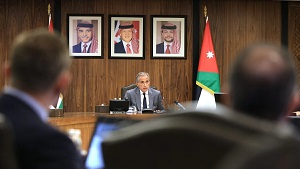
AMMAN — Prime Minister Jafar Hassan, during a Cabinet session on Sunday, said that Jordan remains strong amid a regional crisis with global repercussions.
Hassan reiterated that, “from day one, Jordan has rejected being a battlefield.”
“We have not been a launchpad for attacks, nor have we threatened any party or used militias to target or attack anyone,” Hassan said, underscoring the Kingdom’s neutrality and commitment to peace and constructive relations with all nations.
The prime minister attributed Jordan’s enduring strength to the wise Hashemite leadership, the dedication of its army and security agencies, and the resilience of its people, who, he said, have continued to build the homeland despite wars, crises, and challenges.
“Over the past 25 years, the region has faced major conflicts and crises,” Hassan said, stressing that protecting Jordan’s stability has been, and will remain, an unwavering priority.
Hassan emphasised the Kingdom’s resilient, adaptable economy, which has enabled it to overcome challenges and defy doubts about its strength. He also commended the Jordan Armed Forces- Arab Army (JAF) and security agencies for safeguarding the Kingdom’s skies, land, and sovereignty.
“They uphold their pledge, serve as a source of reassurance, and are a point of pride for His Majesty the King and all Jordanians. We salute their "extraordinary" efforts in intercepting hundreds of drones and missiles aimed at our homeland,” he said.
The prime minister also reiterated the Kingdom’s ongoing diplomatic efforts under the leadership of His Majesty King Abdullah to achieve comprehensive de-escalation, stop the war, and protect the security of Arab countries targeted by Iran, providing a foundation for regional and global stability.
Hassan also highlighted the importance of Arab unity, warning of severe repercussions if regional countries fail to act collectively and stressing that Jordan’s national interests remain the top priority in all decisions.
Hassan also said that the government has implemented “proactive” measures to keep economic activities and supply uninterrupted and maintain strategic reserves.
He emphasised steps taken to protect the private sector and safeguard key economic indicators, “which continue to improve despite ongoing regional challenges.”
The Premier added that the government has cooperated with the private sector to ensure supply chain continuity, stable provisioning, and price stability.
"Legal and regulatory measures have been implemented to protect citizens against rising costs, curb monopolistic practices, and address obstacles in the commercial and industrial sectors."
He underscored support for both military and civilian institutions in providing essential goods at affordable prices, including implementing price caps on basic commodities amid unjustified price hikes.
"The government is closely monitoring stock levels, intervening when necessary through direct imports, and taking strict action against hoarding and market exploitation, including fines of up to JD10,000, business closures, and, in severe cases, imprisonment."
Hassan also assured that the strategic reserves of goods and energy remain secure and that Aqaba port operates efficiently, with alternative land routes and Mediterranean ports are ready to use.
He said that the Kingdom’s airspace remains open with Royal Jordanian Airlines maintaining worldwide flights.
On energy, Hassan noted Jordan’s response to the global surge in prices through a gradual pricing policy, ensuring that increases are not fully passed on dpmestically.
"The Kingdom’s diversified energy sources, including liquefied gas, oil shale, renewable energy, and upgraded facilities in Risha, have helped mitigate the impact, though the energy and electricity sectors have incurred costs exceeding JD150 million in the past month."
Hassan also announced measures to support the tourism sector amid regional instability while maintaining momentum on strategic national projects, including the National Water Carrier, nearing final financial closure, and railway projects linking Aqaba with Shidiya, Maan, and the phosphate sector. Agreements for these projects are expected in the coming month.
The prime minister also highlighted the conflict’s lesson on the importance of enhancing Arab cooperation in transport, trade, logistics, and joint industrial projects.
He said that Jordan is increasingly recognised as a regional hub for supply and distribution, with ongoing discussions to expand partnerships with Arab and friendly countries in manufacturing, agriculture, technology, and transport infrastructure, including ports and railways.
“The war will eventually end, the task ahead is for Jordan and Arab nations to fortify their strategic, security, and economic resilience.”
Latest News
-
 12 US troops wounded in Iran strike on Saudi base- reports
-
 Yemen's Houthis launch first missile attack on Israel during Mideast war
-
 Ground options raise fears of wider war in Iran conflict
-
 Iran fires three missiles towards Jordan, two shot down — JAF
-
 US weighs sending up to 10,000 troops to Middle East — reports