- Last Update09-Dec-2025


- Tweet
-
Amra City and the future Jordanian: Why urban design matters - By Nermeen Murad, The Jordan Times
When I heard that the government is planning a long-term urban expansion over the next 25 years which will incrementally metamorphize into a new futuristic smart city called Amra, the key question that came to mind is who and what is the “future Jordanian” or future citizen we envision will be “produced” hand in hand with the urban space we are designing?
Prime Minister Jaafar Hassan, in my opinion, was clear that “…the project aims to become a model future city for youth and the next generation.” I believe he implicitly defined that this city is for the upcoming generation of Jordanians and linked the city’s built environment directly to the social and generational future of the country.
I believe his statement carried a promise and maybe even a revolutionary message that we are in dire need to address.
What he appeared to be saying is ... yes, the government is structurally building a city that is cognizant of and responsive to technological advances, the environment, latest architectural design trends, transport links, culture, entertainment, etc but the implicit message, as I read it, is that the new design will not only be physical. It will also mirror our vision for the Jordanian of the future.
And I am going to take a step forward and suggest that I understand what elements of the social and generational future of the country Hassan may be indirectly invoking by his emphasis on future generations and youth.
In scholarly terms, this refers to several trajectories all at once. There is a well-established stream of urban planning, urban sociology, and political theory literature that treats quality of life, urban design, and the built environment as directly connected to rights whether those are citizenship, gender, labour, disability, the elderly, youth, or spatial justice rights. It is also directly linked to responsibilities - for example civic behaviour, environmental stewardship and collective norms - and ultimately also connected to positive citizen formation answering questions on who the citizen is, how they behave and what are they entitled to.
The core idea, and this is so critical, is that cities do not simply “house” citizens; they “produce” forms of citizenship.
And this brings me to the context that made me focus on the socio-political impact of what appear to be holistic plans for urban expansion that are not only going to produce a new and structurally exciting urban architecture but also act as a model. One which can be applied to other urban centres in the country as a social, and arguably political, construct for our youth’s future.
And here is the context. We have all read and heard disparate voices here and there (mostly on social media) which challenge the narrative of cohesion of Jordanian citizens and question whether they are all rallying around their one nationality and citizenship.
I don’t want to delve deeply into the aspirational or personal motivations behind these voices because doing so would only give them credence when none is due. But politically these voices are unsafe. They are unsafe because they basically weaponize “identity” and “citizenship” and try to turn them into a policing tool, conflate belonging with obedience, and remove the distinction between national attachment and permissible critique and collapse patriotism into conformity. Equally importantly these voices lay blame on individuals they want to prosecute or at least intimidate, instead of positively promoting the elements of the system that build social and political cohesion and ultimately a nationalism based on shared experiences.
Urban design is never neutral. It is an architecture of social expectations and political possibility. If the future driven city of Amra is to be a model city, then it must model not only infrastructure and technology, but also the kind of civic life we want for Jordan and I think that is what Hassan was alluding to.
For the future of our youth, a city that nurtures diversity in cultural activities, sports, entertainment, environmental consciousness, employment and technological advancement which also fosters trust, fairness, participation and shared experience, is a city that generates a durable, confident sense of citizenship.
And this is where the city of Amra becomes more than an urban project. It becomes a platform to deliberately design the kinds of shared spaces, services and daily interactions that shape how future generations will understand citizenship and community. It is also the space where the government can embed the normative and governance frameworks that shape the kinds of community relationships it seeks to foster.
If planners prioritise accessible public transport, green areas that invite families and youth, cultural and recreational spaces that encourage mixing, and neighbourhoods designed around inclusion rather than separation, then the city of Amra can nurture a confident and cohesive urban life. These are the everyday building blocks of belonging: places where people meet, participate, contribute and recognise themselves in a shared future.
In this sense, the physical choices we make today about walkability, mobility, housing diversity, public amenities, safety, and environmental care might appear at first glance to be only architectural or structural, but in reality these will be the choices that quietly define the Jordanian citizen we want.
If the future city of Amra is able to embed this vision and if it becomes a place where different Jordanians live, work and interact within a framework of fairness and opportunity, then it will quietly and powerfully shape the political culture of the next generation and truly become the model for future generations.
The built environment will shape the political character of its residents whether we intend it or not. That is why the social design of the city of the future must be every bit as ambitious as its physical one. Prime Minister Hassan promised us that “…the project aims to become a model future city for youth and the next generation,” understanding, I believe, that the city we build today will help determine the political community we inherit tomorrow.
Latest News
-
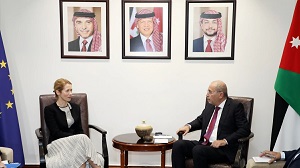 Foreign minister, EU's Kallas discuss preparations ahead of Jordan — EU summit
-
 Netanyahu says will meet Trump, expects Gaza truce to enter phase two “shortly”
-
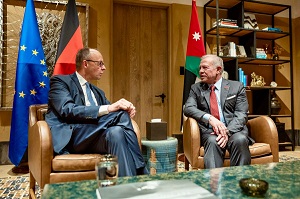 King meets with German chancellor, discusses cooperation, regional developments
-
 Trump strategy shifts from global role and vows 'resistance' in Europe
-
 Jordan beat Kuwait to reach Arab Cup knockout stage