- Last Update23-Nov-2026


- Tweet
-
The Gulf’s security illusion shattered - By Mohammad Abu Rumman, The Jordan Times
Over three days in Doha, the Arab Center for Research and Policy Studies held the 13th Gulf Studies Forum, focusing on Gulf security and the US-Israeli war against Iran. The discussions featured bold papers and remarkably candid interventions by scholars from across the Gulf. Rather than avoiding uncomfortable questions, participants confronted them head-on, reflecting a growing awareness that the region faces profound structural challenges, not merely temporary crises.
Assessments varied. Some viewed the emerging threats as serious strategic and security challenges, while others went further, describing them as existential. Yet a broad consensus emerged around two seemingly contradictory realities. First, Gulf states cannot afford, at least for the foreseeable future, to abandon the American military and security umbrella. Second, that same umbrella can no longer guarantee protection in the traditional sense. The security doctrine that has guided the Gulf for decades is increasingly untenable. In other words, the Gulf has reached a historic crossroads.
The paradox is striking. Within a few years, the Gulf has moved from a comfortable sense of distance from the region’s major conflicts to finding itself at their very center. Regional and international rivalries have steadily drawn closer, from the war in Yemen and Houthi attacks on Saudi Arabia to repeated Iranian attacks on Gulf states. The crisis surrounding the Strait of Hormuz, and the prospect of one power dominating this vital passageway, has exposed the vulnerability of economies still heavily dependent on oil revenues.
This brings us back to an influential argument advanced by Emirati political scientist Abdulkhaleq Abdulla, a former adviser to Abu Dhabi’s crown prince and a provocative voice in Gulf political debates. In his 2018 book The Gulf Moment in Contemporary Arab History, Abdulla argued that the center of gravity in the Arab world had shifted toward the Gulf states.
That argument coincided with a broader intellectual trend suggesting that the Middle East was not a single geopolitical space but a collection of distinct “Middle Easts.” From this perspective, the Gulf could distance itself from the ethnic, sectarian, and nationalist struggles that had long consumed the wider region, including the Arab-Israeli conflict. The Gulf represented a different model: wealthy, confident, development-oriented, and focused on economic transformation. Dubai, Doha, Riyadh, and NEOM embodied this vision.
Today, that thesis appears to have collapsed spectacularly.
The Gulf cannot detach itself from the geopolitical realities and crises of the Middle East. The war against Iran offers perhaps the clearest demonstration. Launched by the United States and Israel on February 28, the war was one in which the Arabs had neither a hand nor a stake, as several forum participants observed. Yet Gulf states ultimately paid the heaviest price, economically, strategically, and psychologically.
The war has also underscored another fundamental reality: Iran is not going anywhere. Geography cannot be changed. Iran is not simply a political regime but a state, a society, a history, and a civilization.
If one conclusion is that the United States remains an indispensable strategic partner in the short term, another is equally important: Iran cannot be permanently isolated. Gulf states must therefore explore ways of dealing with the existing Iranian regime, despite its hostile behavior toward the Gulf and the wider region, rather than building their strategies around expectations of its collapse. Should that regime eventually fall, the decisive forces are more likely to emerge from within Iran than from external military intervention.
This leads to a more fundamental question that should now dominate Gulf strategic thinking: What does Gulf security actually mean?
The challenge goes far beyond military protection arrangements. It requires redefining the geographical and political boundaries of Gulf security itself. Does that security architecture include Yemen? What place should Iraq occupy within it? Where does Jordan, a longstanding friend and strategic ally, fit into this equation? Should the Gulf seek closer strategic integration with Jordan, or maintain its current distance?
Equally important is the need for an honest assessment of the strengths and vulnerabilities of the Gulf states, both collectively as a regional system and individually as sovereign actors.
It is neither realistic nor strategically coherent to imagine Gulf security without resolving the Yemeni crisis, developing a clear framework for cooperation with Iraq, or establishing a more substantive relationship with Jordan that moves beyond diplomatic courtesies.
These are the questions Gulf policymakers must confront.
The new strategic awareness evident at the Doha forum represents an important step forward. Yet awareness alone is insufficient. It must be translated into a coherent vision capable of redrawing the region’s security map around one fundamental recognition: The Gulf is part of the Middle East, not an island insulated from its conflicts.
Latest News
-
 Crown Prince to CNN: Investment conference a major milestone in Jordan-EU relations
-
 Trump, Xi and Putin's Pledge to Boost Refined Oil Product Supplies Faces Implementation Hurdles
-
 Gulf nations on alert after US strikes Iranian island
-
 Prime minister attends signing of $6.6 billion Water Carrier Project agreement
-
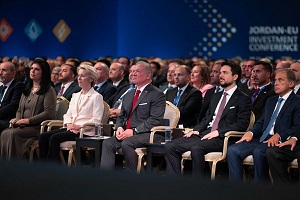 King at Jordan-EU Investment Conference: Jordan is ready for investors