- Last Update17-Apr-2026


- Tweet
-
From trade deficit to value creation: The case for agro-industrial integration in Jordan - By Mohammad Najeeb, The Jordan Times
Jordan’s persistent trade deficit remains one of the most structural challenges confronting the national economy. Despite sustained efforts to expand exports and rationalize imports, the imbalance between domestic production and consumption continues to place pressure on foreign currency inflows, fiscal planning, and long-term economic resilience. Addressing this challenge requires more than short-term trade measures; it demands a structural shift that enhances domestic value creation and repositions productive sectors as engines of export growth.
A significant share of Jordan’s trade deficit is linked to food and agro-related imports, alongside an export base that remains concentrated in primary and semi-processed goods. While agriculture contributes an estimated four to six percent of gross domestic product, its role in export generation remains limited due to the predominance of raw output with low value added and high exposure to market volatility. This dynamic does not reflect a lack of productive capacity, but rather a structural gap in integrating agricultural production into industrial and trade-oriented value chains.
National and international development assessments indicate that approximately ten to twelve per cent of Jordan’s total land area is potentially suitable for agricultural use under varying irrigation and climatic conditions. However, sectoral estimates suggest that nearly thirty to forty percent of this land remains underutilized or operates below optimal productivity levels. Even where production is active, post-harvest losses in certain crops are estimated to exceed twenty per cent, largely due to limited storage, transportation, and local processing capacity. The result is a dual economic loss: foregone export revenues and continued dependence on imported processed food products.
This challenge is further compounded by Jordan’s severe water scarcity. The Kingdom ranks among the most water-scarce countries globally, with renewable freshwater availability far below international water poverty thresholds. Agriculture alone is estimated to consume more than half of available water resources, often under production models that deliver limited economic return per unit of water. Climate variability, population growth, and regional pressures continue to intensify demand on already constrained supplies, making water productivity a central economic issue rather than a purely environmental one. Yet water scarcity, if managed strategically, can become a catalyst for economic restructuring. International experience demonstrates that countries facing acute water constraints have improved trade performance by aligning agricultural production with high-value, water-efficient, export-oriented processing. Jordan has already invested significantly in wastewater treatment infrastructure, but treated wastewater remains underutilized in several agricultural zones. Expanding its use for irrigation offers one of the most cost-effective pathways to support agricultural production while preserving freshwater for domestic and industrial use.
In parallel, accelerating the adoption of precision irrigation technologies, such as advanced drip systems and smart water monitoring, can substantially improve efficiency. Evidence from comparable economies suggests that modern irrigation practices can reduce agricultural water consumption by up to thirty percent while improving yield quality and consistency. Equally important is the strategic realignment of crop selection toward varieties that generate higher export value with lower water intensity, ensuring that scarce resources are directed toward maximum economic return.
Integrating agriculture with industry transforms these water and land constraints into opportunities for value creation. Agro-industrial development enables economies to move up the value chain by converting primary outputs into processed, branded, and export-ready goods. Development studies consistently show that every dollar invested in agro-processing can generate two to three dollars in value-added output, while processed food products often account for ten to fifteen percent of total exports in emerging economies. Jordan’s current export structure indicates significant untapped potential in this regard.
Reframing agriculture as a component of national trade and industrial policy, rather than a standalone sector, provides a realistic pathway to narrowing the trade deficit. Agro-industrial integration can simultaneously enhance export diversification, reduce reliance on imported food products, and stabilize foreign currency inflows. Each unit of agricultural production that undergoes domestic processing and enters export markets in higher-value form contributes more effectively to improving the trade balance than reliance on raw exports or consumption-focused farming.
From a fiscal perspective, this transition carries direct benefits for budget sustainability. Expanding domestic processing increases taxable economic activity without raising tax rates, while import substitution reduces exposure to global price volatility and supply disruptions. Over the medium term, these structural gains support a more resilient current account position, generate employment in rural and semi-urban areas, and reduce long-term fiscal pressures linked to unemployment and regional disparities.
Jordan’s trade deficit should not be viewed solely as an external vulnerability, but as an indicator of unrealized domestic value creation. The Kingdom possesses the geographic location, human capital, and agricultural base necessary to build a competitive agro-industrial economy capable of serving both domestic and regional markets. The central challenge lies in aligning agricultural production with industrial processing, export development, water efficiency, and investment mobilization within a coherent national framework.
Transforming agriculture into an integrated industrial and trade-driven sector represents more than a development initiative; it is a strategic economic shift capable of strengthening fiscal stability and external balance simultaneously. By embedding water efficiency, value-added processing, and export orientation at the core of agricultural policy, Jordan can move from managing trade deficits to generating sustainable economic value. The path from trade deficit to value creation is not only achievable. It is increasingly essential for securing Jordan’s long-term economic resilience.
Latest News
-
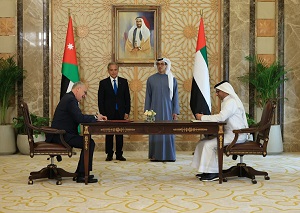 Jordan, UAE sign deal to implement landmark Aqaba Railway Project
-
 Pakistan working to set second round of US, Iran talks — source
-
 Lebanon-Israel talks open amid widening gap between diplomacy, war
-
 King reviews government progress in public sector modernisation
-
 US-Iran talks fail, raising fears of renewed escalation