- Last Update28-Sep-2026


- Tweet
-
UN Women, EU partner to accelerate women's employment in MENA
The Jordan Times
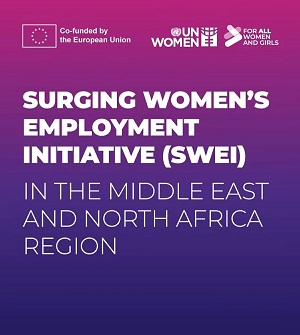
AMMAN — The European Union (EU) and UN Women are joining forces to accelerate women's employment across the Middle East and North Africa through the Surging Women's Employment Initiative (SWEI).
This regional flagship initiative brings together governments, the private sector, financial institutions, development partners, civil society and UN agencies to address the region's low levels of women's participation in the labour market.
The partnership, launched in the margins of the 81st UN General Assembly High-Level Week, comes at a critical moment for the Middle East and North Africa (MENA) which has one of the world's largest youth cohorts entering the labour market.
While women's labour force participation has remained at around 20 per cent on average for more than two decades.
MENA economies need to absorb more of their human capital. Narrowing the employment gap between women and men could significantly increase regional GDP as much as 60 per cent and generate greater productivity, innovation and economic resilience.
SWEI aims to help change this trajectory, targeting an increase in women's employment by 5 per cent by 2030, according to a statement by UN Women Arab States.
SWEI is a key initiative of the EU’s Pact for the Mediterranean, which prominently supports gender equality in the southern Mediterranean.
With the EU’s support, SWEI will focus on three areas; advancing legal and macroeconomic reforms for private sector-led, job-rich growth; engaging businesses to expand women's employment, and developing innovative employment models in the care, green and Science, Technology, Engineering and Mathematics (STEM) economies, backed by public-private financing and strategic investment.
European Commissioner for the Mediterranean Dubravka Šuica, said "Through the Pact for the Mediterranean and our 10 euro million contribution to the Surging Women's Employment Initiative, we are working with UN Women to turn ambition into action."
Šuica added "The initiative's overall goal is to create 500,000 jobs for women and increase women's employment by 5 per cent by 2030, through investment in skills, entrepreneurship and opportunities in sectors with huge potential."
UN Women Regional Director for the Arab States, Moez Doraid said "The region cannot realise its full economic potential while women remain significantly underrepresented in the labour market."
He added "Thanks to UN Women’s partnership with the European Union, SWEI is bringing policy reform, investment and private-sector action together around a measurable, time-bound goal: significantly increasing women's employment in the Arab States by the end of the decade, the target date for achieving the Sustainable Development Goals."
The partnership builds on the growing commitment of several Arab governments to boost women's economic participation.
To date, UN Women and partners have contributed to the reform of 20 laws to support women's economic participation, while more than 900 companies in the Arab States have signed the Women's Empowerment Principles (commitments undertaken by companies to women equality).
US$25 million in donor funding has been mobilised from Sweden, Spain and Finland including 10 million euro from the European Union, alongside financing from the Islamic Development Bank.
The partnership provides a clear example of global efforts to accelerate women's economic participation and empowerment.
Latest News
-
 Jordan condemns Houthi missile attacks on Saudi Arabia
-
 Safadi denounces Iranian attacks on Jordan, Arab states
-
 Jordan will stand against any attempt to resolve Palestinian issue at Its expense — Safadi
-
 King’s UN address puts Israel, international community on notice over Gaza, West Bank
-
 Golan will remain Syrian, vows President Al Sharaa at UN