- Last Update09-Nov-2026


- Tweet
-
Jordan-Syria ties at strongest point in history — Safadi
The Jordan Times
DAMASCUS — Deputy Prime Minister and Foreign Minister Ayman Safadi on Monday reaffirmed Jordan’s unwavering support for Syria, stressing that its security and stability are integral to those of Jordan and the wider region.
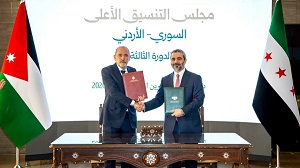
Speaking at a joint press conference with Syrian Foreign Minister Asaad Al Shibani following the third session of the Jordanian-Syrian Higher Coordination Council in Damascus, Safadi said that Jordan will continue to support Syria’s efforts to achieve security and stability and rebuild a free and secure country that fulfils the aspirations of its people and ensures them a dignified life.
“Jordanian-Syrian relations have reached their strongest point in history,” Safadi said, describing the ties between the two countries as rooted in brotherhood, mutual affection and a shared history, destiny and future.
He added that he had conveyed a message from His Majesty King Abdullah to Syrian President Ahmad Al Sharaa, reaffirming Jordan’s commitment to strengthening relations between the two countries.
Safadi said that the broad ministerial participation in the council’s meeting, following a similarly high-level gathering in Amman, reflected tangible progress in bilateral relations. He also recalled that he was the first Arab foreign minister to visit Syria following the revolution.
“Nearly two years after its liberation, Syria was in a better position than even the most optimistic expectations at the outset of its reconstruction process,” he said.
The council reviewed bilateral relations and progress in implementing the outcomes of its second meeting, held in Amman last April. The ministerial session was preceded by preparatory discussions involving ministry secretaries-general and technical teams from both countries.
The meeting concluded with the signing of 11 cooperation documents covering investment, civil aviation, food security, finance, agriculture, environment, youth, public administration and education, in addition to scholarships, academic exchange and cloud seeding in the Yarmouk River Basin.
Safadi said that both sides were proud of the progress achieved, while stressing that their ambitions remained high and opportunities for further cooperation were extensive.
“The talks reflected the spirit of brotherhood and mutual affection between the two countries, as well as their shared determination to work together in the interests of both peoples,” he said.
He added that Jordan and Syria would continue to deepen and consolidate cooperation in a manner that serves their mutual interests and reflects their bonds of kinship, shared history and common future.
Joint strategic projects
Jordan and Syria agreed to advance several joint strategic projects, including rehabilitating the international highway linking the two countries at a cost of $47 million and upgrading the Jaber-Nassib border crossing to operate around the clock.
Al Shibani said the crossing would be upgraded through the introduction of separate lanes for trucks and passengers, alongside the establishment of an electronic customs link between the two countries.
The two sides also signed a memorandum on railway connectivity, paving the way for a regional corridor linking Saudi Arabia, Jordan, Syria and Turkey.
They further agreed to study the establishment of a joint economic city along the border, modernise the joint free zone and activate the Jordanian-Syrian Joint Business Council.
Al Shibani said the council's meetings covered 19 sectors, while a joint strategic projects team had identified 42 projects across nine key areas during a meeting held in Damascus last September.
He added that the foreign ministries of both countries had been tasked with submitting monthly progress reports to the council's presidency to monitor implementation. Each agreement would have a specific timeline and a designated entity responsible for carrying it out.
On regional security, Safadi reiterated that Syria's security and stability were essential to Jordan's, describing the country as a key pillar of regional stability.
He said that the aspirations of the Syrian people were shared by Jordanians and that Syria's success would contribute to security across the region and beyond.
He underscored the importance of continued cooperation in combating terrorism and other security threats, noting that bilateral coordination in this field was at its strongest.
Jordan and Syria were also working together to secure their borders and combat drug trafficking, which Safadi described as a common threat requiring joint efforts.
Safadi reaffirmed Jordan's support for Syria in confronting Israeli attacks, calling on Israel to withdraw from all Syrian territories occupied since December 8, 2024, respect the country's sovereignty and end violations targeting its security and stability, particularly in southern Syria.
He condemned the attacks as violations of international law and Syrian sovereignty, warning that they posed a serious threat to regional security. “Jordan and Syria were closely coordinating efforts to halt the attacks and prevent attempts to undermine stability in southern Syria.”
Safadi called on the international community to take action to stop the attacks before they trigger further escalation, recalling His Majesty’s address to the United Nations General Assembly, in which the King warned against Israeli violations of Syria's sovereignty and interference in its security.
He also said that Jordan and Syria shared similar positions in rejecting Israeli aggression against Syria and illegal measures in the occupied West Bank, which entrench the occupation and deny Palestinians their right to freedom and a dignified and secure life.
Safadi stressed the need to address Israeli measures obstructing the delivery of humanitarian assistance to the people of Gaza.
He reaffirmed Jordan's support for all measures taken by Syria to safeguard its security and stability, stressing that the life of every Syrian citizen was as precious to Jordan as that of every Jordanian.
Safadi arrived in Damascus heading the Jordanian delegation to the council's third session, where he was received by Al Shibani.
The two ministers held talks attended by Syrian Defence Minister Maj. Gen. Marhaf Abu Qasra, the chiefs of staff and intelligence directors of both countries, and senior military and security officials.
Safadi also recalled the role of the Jordan Armed Forces-Arab Army (JAF) in providing refuge to Syrian women and children fleeing repression and bombardment under the former regime.
He stressed that the ties between the two countries and their peoples, built on trust and deep-rooted social and family bonds, were stronger than any challenge.
Latest News
-
 Iranian forces 'stronger' than at beginning of war — army spokesman
-
 King, Kazakhstan president chair new round of Aqaba Process meetings in Astana
-
 Crown Prince observes advanced drone tech demonstrations in Estonia
-
 King in talks with Kazakhstan president: Jordan will not falter in its fight against terrorism, extremism
-
 Crown Prince meets with Estonia PM