- Last Update06-Sep-2026


- Tweet
-
From university to global labour market: A national strategy for internationalisation of Jordanian higher education - By Hasan Dajah, The Jordan Times
The number of students admitted or the degrees awarded annually can no longer measure the success of universities. Rather, it is measured by their ability to graduate competent individuals capable of competing for and securing employment opportunities both within Jordan and abroad. Given the saturation of the Jordanian market in a large number of specializations, and the high number of graduates compared to available opportunities, it has become essential to move from the concept of "graduating students for the local market" to a more ambitious strategy based on "graduating students for the international labor market."
I previously proposed the idea of initiating the teaching of a range of social science and humanities disciplines in English. A thorough discussion ensued regarding the available resources and anticipated challenges. The proposed disciplines included law, international relations, business administration, economics, and accounting, as these are among the fields most closely linked to multinational corporations, international organizations, and cross-border markets. The idea was not simply to change the language of instruction, but rather to restructure university programs based on international standards and global employment requirements.
English as a tool for professional empowerment: Engineering, pure sciences, and medical sciences are taught in English to varying degrees at Jordanian universities, while the majority of social sciences and humanities programs are still taught in Arabic. Despite the importance of Arabic as a national and scientific language, limiting it to English in some programs may restrict graduates' ability to engage with international legislation, foreign research, global databases, and multicultural business environments.
Teaching law in English, for example, can open up fields such as international commercial arbitration, international law, corporate compliance, cross-border contracts, and intellectual property rights for graduates. Similarly, teaching international relations in English gives students greater access to international organizations, diplomatic missions, research centers, and international NGOs. As for business administration, economics, and accounting, internationalizing these fields increases graduates' employment opportunities with multinational corporations, banks, auditing and consulting firms, international financial institutions, and shared service centers. Therefore, English is not an end in itself, but rather a means to access global knowledge, master professional terminology, and work in international environments.
This shift does not imply weakening or marginalizing Arabic. Instead, a bilingual model can be built that preserves the student's ability to express themselves professionally in Arabic while simultaneously equipping them with the necessary skills for work, research, and communication in English. For example, a law graduate needs to understand Jordanian legislation in Arabic, but also needs to draft contracts and legal correspondence and interact with international references in English.
A gradual approach, rather than a sudden shift: The success of this project requires a gradual and well-considered approach. It could begin by introducing international tracks within some existing programs, allowing students to choose between an Arabic track and one where a significant portion of the curriculum is taught in English. After evaluating the experience, this could be gradually expanded to fully integratedinternational academic programs. In the first phase, a limited number of internationally oriented courses can be selected, such as international law, commercial arbitration, international relations, international economics, international business administration, global marketing, and international accounting. This gradual approach helps assess the readiness of both students and faculty, and identify training and technical needs before expanding the program.
Students should not be admitted to the international track based solely on their high school GPA, but rather through a genuine language proficiency test. A preparatory year or intensive courses should be offered for students who need to improve their language skills. These courses should include academic language, professional writing, presentations, negotiation, and report and resume writing, and job interview skills.
Addressing the shortage of qualified faculty: A significant challenge is the lack of qualified English-speaking faculty, but it is not an insurmountable obstacle. This can be addressed through two complementary approaches: first, developing the skills of existing faculty members who have completed their undergraduate and doctoral studies in English; and second, attracting new qualified faculty. The first track requires intensive training programs for faculty members in English language teaching, international course design, modern assessment methods, and digital teaching. Financial and academic incentives can also be offered to professors who develop courses in English, obtain international professional certifications, or participate in teaching joint programs.
The second approach involves including actual proficiency in teaching English among the new appointment requirements, prioritizing graduates of universities where English is the language of instruction, and those with international academic or professional experience. Jordanian professors working abroad can also be utilized through flexible contracts that allow them to deliver some courses remotely or during intensive academic periods.
While individual Jordanian universities do not possess a sufficient number of professors specializing in all specific fields, Jordanian universities collectively possess a substantial human and academic resource. Therefore, there is a need to establish a national network of teaching competencies, including a comprehensive database of faculty members capable of delivering courses in English, along with their specializations, experience, and professional qualifications.
Through this network, courses can be distributed according to proficiency, allowing a professor to teach a suitable course to students at multiple universities. If a professor is located at a distant university, they can deliver lectures via video conferencing systems, with an assigned academic supervisor at the host university to monitor students and organize exams and practical activities. This model can be developed into a "joint national university lecture hall," where students from multiple universities enroll in a single course taught by the best available professor in the field. This achieves genuine integration among universities, reduces costs, raises the quality of teaching, and prevents the duplication of similar programs without sufficient expertise.
Another strategic proposal is to localize distinguished international programs at specific universities instead of distributing them randomly. The most suitable university can be selected based on its location, capabilities, expertise, and international relations to become a national center for a particular program or track. For example, one university might specialize in international relations and diplomacy, another in arbitration and international commercial law, a third in digital economics, and a fourth in accounting and international financial standards.
This does not mean that the university has a monopoly on the specialization, but rather that it leads a national network in which other universities participate through teaching, supervision, research, and training. Students can take some courses in person at their home university and others online at the university hosting the program, with mutual recognition of credit hours. This model offers Al-Hussein Bin Talal University a significant opportunity to lead international programs aligned with its location and developmental mission, particularly in the fields of international relations, strategic studies, international tourism management, development economics, heritage management, and cross-border business.
Teaching in English alone will not suffice if curricula remain traditional and disconnected from job market demands. Therefore, study plans must be updated in collaboration with employers, chambers of commerce, banks, auditing and consulting firms, international organizations, and graduates working abroad.
International professional certifications should be integrated into university programs, especially in accounting, project management, risk management, financial analysis, compliance, human resource management, and data analysis. Students should also complete real-world practical training, a graduation project addressing a problem within an organization or company, and build an online professional portfolio showcasing their work, research, certifications, and skills before graduation. Universities can establish specialized international employment offices to search for training and job opportunities outside Jordan, build partnerships with multinational companies, and assist students in preparing resumes, acing interviews, and understanding different work cultures.
International programmes should not become elitist pathways accessible only to the financially able. Therefore, it is crucial to provide scholarships and language support for high-achieving students from all governorates, establish strong language centers within universities, and make digital materials and language labs available at affordable prices.
Programs should also be subject to periodic evaluation based on clear indicators, including graduates' language proficiency, the percentage of graduates obtaining professional certifications, the number of participants in international training, employment rates both within and outside Jordan, and employer satisfaction. Success is not measured by the number of programs labeled "international," but rather by their ability to create a real difference in graduates' opportunities.
The shift from graduating students for the local market to graduating them for the international job market is no longer a luxury, but a national imperative to address unemployment and invest in Jordan's human capital. This requires institutional will, collaboration among universities, faculty development, bilingual programs, and partnerships with the private sector and international organizations.
Jordan possesses exceptional human capital and a strong educational reputation, but it needs a national project that transforms these advantages into global competitiveness. When students become bilingual, possess specialized knowledge, digital skills, practical experience, and professional certifications, they will no longer be confined to a limited local market but will become highly skilled Jordanian professionals capable of competing and contributing anywhere in the world.
The writer is professor of strategic studies at Al-Hussein Bin Talal University
Latest News
-
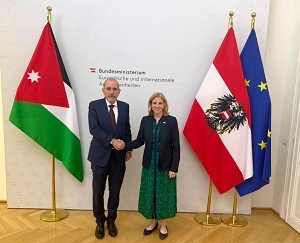 Safadi, Austrian foreign minister discuss bilateral relations, regional developments
-
 Ukraine, India discuss Black Sea, food security on FM's 'historic' Kyiv visit
-
 Trump Floats Renaming Strait of Hormuz as 'Trump Strait'
-
 Palestinian prime minister visits Jordan Field Hospital in Nablus
-
 King visits National Press, inaugurates new expansion project