- Last Update25-Sep-2026


- Tweet
-
Reimagining the Baptism Site - By Mohammad Abu Rumman, The Jordan Times
The opening of the Orthodox International University at the Baptism Site represents far more than the addition of another institution to Jordan’s higher-education landscape. The university stands at the site where Jesus Christ was baptized, one of Christianity’s holiest and most symbolic places, inscribed on UNESCO’s World Heritage List since 2015.
The real question, therefore, goes beyond the university itself. It is about what this institution could become in the years ahead, and the role it might play in redefining the significance of the Baptism Site itself — nationally, regionally and globally.
The university will naturally begin on a modest scale. Its current residential capacity is forty students, alongside opportunities for distance learning. Yet projects of this kind should not be judged by their size at the moment of their establishment, but by the trajectory they may follow and the potential they carry for future development.
Established as a non-profit institution by the Greek Orthodox Patriarchate of Jerusalem, the university offers an interdisciplinary programme combining theology, philosophy, law and languages, as well as master’s programmes in Canon Law, Orthodox Spirituality, and dialogue and comparative spirituality between Orthodox Christianity and Islam. This provides a foundation upon which a broader academic identity can be built — one that transforms the university into a space for the study of religion, philosophy, ethics and interfaith dialogue.
Its greatest added value, however, lies in the place itself. The Baptism Site should not merely serve as the university’s geographical address; it should become an integral part of its philosophy and mission. There is a fundamental difference between a sacred place that functions primarily as a destination for pilgrimage and visitation, and one that also becomes a living space for knowledge, reflection and dialogue — where students and scholars live, study texts, religions and philosophies, and engage with the great ethical questions of humanity.
The university has already incorporated the study of the “Great Books” into its programmes. This opens the door to a vision extending beyond theological education in the narrow sense, towards a deeper engagement with the broader humanistic and philosophical heritage.
This foundation could be developed much more ambitiously. The university could gradually evolve into a regional centre for religious studies, interfaith dialogue and ethical thought. Its role need not be confined to granting academic degrees. It could host theologians, scholars of religion, philosophers, and Muslim, Christian and Jewish researchers; organise summer schools, international conferences and programmes for young scholars; establish academic chairs in Muslim-Christian dialogue and the study of Arab and Eastern Christianity; and create a specialisedcentre for the study of pilgrimage, sacred places and religious heritage.
Such a role acquires even greater significance when viewed in the context of the Amman Message and the role Jordan has sought to play over recent decades in promoting religious moderation, recognising pluralism and respecting difference. The challenge today is to move this message beyond discourse and individual initiatives towards the construction of sustainable institutions of knowledge.
The university could become one such institution, giving Jordan’s approach to religious dialogue and pluralism an international academic and research dimension — one grounded less in preaching and more in knowledge, scholarship, and serious intellectual and philosophical debate.
The need for such an institution becomes even more urgent in the current regional climate, amid the troubled return of religious, sectarian and ethnic identities to the political sphere, where they have frequently become instruments of conflict, mobilisation and polarisation.
There is a profound paradox here. Religions possess an enormous reservoir of ethical and humanistic values. Yet when drawn into struggles for power and political competition, they can be transformed from spaces for ethical inquiry and reflection on humanity, life and justice into rigid boundaries separating communities, sources of political legitimacy, and instruments for mobilising mutual fears and constructing images of the enemy.
For this vision to succeed, however, the university must not remain an academic island disconnected from its surroundings. The initiative to commemorate the second millennium of the Baptism of Jesus Christ in 2030 — together with the associated development of infrastructure, services, Christian pilgrimage and the international promotion of the Baptism Site — provides an opportunity to think of the entire area as one integrated project: a destination for pilgrimage and worship, a university for knowledge and dialogue, a cultural and spiritual space, and an infrastructure capable of welcoming visitors, researchers, pilgrims and students alike
Latest News
-
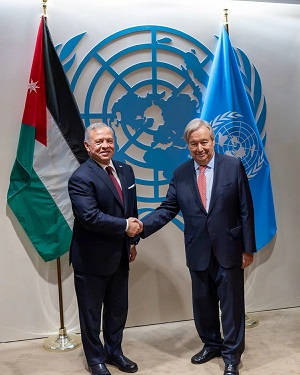 King meets with UN secretary-general, calls for stepping up efforts to restore regional calm
-
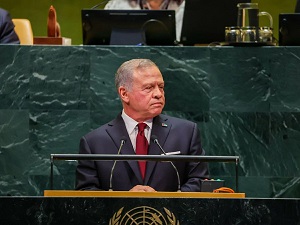 King delivers Jordan’s address at 81st UNGA
-
 Crown Prince meets in New York with CEOs of two global US companies
-
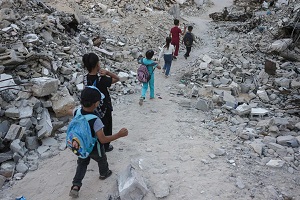 Israel minister vows to force out all of Gaza City if any Israeli abducted
-
 King meets with Kuwait crown prince, Lebanon PM in New York