- Last Update30-Jan-2026


- Tweet
-
Türkiye Steps Up Mediation Efforts Between Iran, US
Asharq Al-Awsat
Türkiye is intensifying efforts to mediate between Iran and the US, seeking to avert a new crisis on its eastern border that could also threaten regional stability, amid escalating threats of a US military strike aimed at toppling the Iranian government.
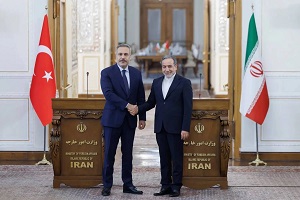
Türkiye’s Foreign Ministry said on Thursday that Iranian Foreign Minister Abbas Araghchi will visit Ankara on Friday, following Türkiye's offer to mediate between Tehran and Washington.
Araghchi’s visit follows a Wednesday phone call with his Turkish counterpart, Hakan Fidan, during which they discussed developments in Iran, US threats, and ways to end the crisis through diplomatic channels and to reduce regional tensions.
Sources at the Turkish Foreign Ministry said Fidan will reiterate Türkiye's opposition to any military intervention against Iran during his meeting with Araghchi in Ankara on Friday, warning of the risks such a step would pose to the region and the world.
The sources said Fidan will stress Türkiye’s readiness to help find a solution to the current tension between Tehran and Washington through dialogue.
He will also discuss bilateral relations between Türkiye and Iran, regional security, and steps to boost cooperation in trade, energy, and transport, as well as expanding cross-border exchanges through frontier trade centers.
They added that Fidan will also address developments in Syria and efforts to combat terrorist organizations, notably the Kurdistan Free Life Party, known as PJAK, and ISIS.
On the eve of the meeting with Araghchi, Fidan met on Thursday with the US ambassador to Ankara and special envoy for Syria, Tom Barrack, at the Turkish Foreign Ministry.
They discussed developments in Iran and ways to ease tensions, as well as the latest situation in Syria, according to Turkish sources.
US threats against Iran have intensified, with Washington signaling it could use force to change the government in Tehran.
In recent weeks, the US has deployed naval fleets and military reinforcements to the Middle East, while Iran has vowed to retaliate against any attack targeting it.
Fidan said on Wednesday that Türkiye rejects any foreign military intervention in Iran, calling on the United States to rely on diplomatic channels to resolve the crisis and warning that destabilizing the region would not serve Türkiye’s interests.
Turkish proposal
Hurriyet newspaper, which is close to the Turkish government, reported that President Recep Tayyip Erdogan has proposed to US President Donald Trump that they hold a three-way video conference with Iranian President Masoud Pezeshkian to mediate and de-escalate tensions.
The paper said the Iran file was the primary focus of a phone call between Erdogan and Trump on Tuesday, during which the Turkish leader reiterated Ankara’s position and proposed addressing the tensions through diplomacy.
It added that Trump responded positively to Erdogan’s proposal.
The call came after a series of Turkish diplomatic moves, including a phone call between Erdogan and Pezeshkian, two successive calls between Fidan and Araghchi, two meetings with US envoy Tom Barrack at the Turkish Foreign Ministry, and a phone conversation between Fidan and US Secretary of State Marco Rubio.
These contacts reflect ongoing Turkish mediation efforts aimed at easing tensions and preventing a strike on Iran that could threaten regional and global stability, the paper said, noting that the moves were carried out quietly as US statements about preparations to strike Iran intensified.
Preemptive measures
Türkiye’s National Security Council discussed developments in Iran and US threats of an attack on Tehran at a meeting chaired by Erdogan on Wednesday. In a statement after the meeting, the council stressed the importance of the stability and peace of “neighboring Iran” for Iran, Türkiye, and regional security.
Türkiye’s Defense Ministry said Ankara continues its efforts to end all conflicts and establish peace and stability in the region.
Defense Ministry spokesman Zeki Akturk said on Thursday that the ministry has taken all necessary precautions in coordination with relevant institutions, in anticipation of any potential adverse developments amid recent US moves and threats to strike Iran.
His remarks followed media reports about contingency plans to establish a “buffer zone” along the border with Iran, in the event of a US attack that could trigger a large-scale displacement from Iran into Türkiye.
According to the reports, the plan includes setting up a buffer zone on the Iranian side of the border if Iran comes under air strikes, to ensure that any displaced people remain within Iranian territory and to prevent their entry into Türkiye, regardless of whether the term “buffer zone” is formally used.
Türkiye’s Defense Ministry has previously said it has stepped up security measures along the roughly 560-kilometer border with Iran, using an integrated surveillance system that includes concrete walls, trenches, and electro-optical watchtowers, as well as round-the-clock monitoring by both crewless and manned aircraft.
Latest News
-
 Safadi, Egyptian counterpart hold talks on Gaza, regional developments
-
 King, Crown Prince visit JAF General Command
-
 US Reports Constructive Talks with Israel's Netanyahu on Gaza Plan
-
 Iraqi Lawmakers to Elect President Tuesday, PM Appointment Next
-
 US Storm Leaves 400,000 without Power, Forces Thousands of Flight Cancellations